Banquet Captain Told the Whole Crew to Look at My Trembling Hand — Then He Read My Name Aloud Without Knowing It Was Mine
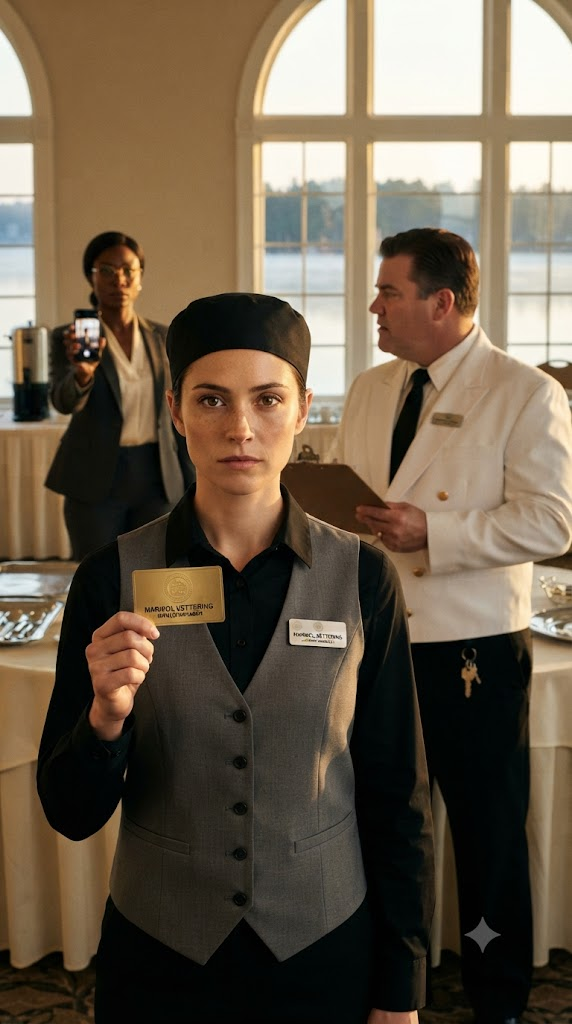
"Guests shouldn't have to look at that," Ross Kettering said, and then he kicked my tray stand halfway across the ballroom floor.
It was 6:42 in the morning. Twenty-two years he'd run banquets at this property, fourteen of them under my father, and he still didn't know the difference between a new hire and the person whose signature had paid for the chandeliers overhead. The title card had been executed nine days ago. It was folded in my vest pocket, and my hand was already closing around it.
I said nothing. That was the plan.
My father died eleven months ago. Before he went, he asked me for one thing: walk the floor for a single shift, unannounced, before the ribbon ceremony. See what the staff sees. See who they're afraid of. I agreed, and I had been dreading it every day since, mostly because of my hand. The tremor came with the grief. It shows when I'm tired, and I was very tired.
Ross had been waiting for someone like me to walk through those doors.
The morning crew was already in position when I came in — two dozen servers in gray vests, a chef brigade behind the pass, Adaeze Osei from food and beverage standing beside the coffee station with her tablet and her phone. Tall arched windows along the east wall, frost still on the lake, sun coming up hard over the tree line. The room smelled like coffee and fresh linen and hot silver polish. It should have been a beautiful morning.
Ross found me before I found my station.
He walked the length of the ballroom with his key ring jangling, starched white coat, gold buttons, silver name tag catching the sunrise, and he stopped in front of me like he'd been waiting for the moment. He looked at my badge first. Hand-laminated, gold-edged, slightly different from everyone else's. I'd hoped nobody would notice. He noticed.
"Staffing agency?" he said.
"Yes."
"Then you're a temp, which means you're not on my list, which means you're already wrong." He flipped a page on the clipboard he carried like a prop. "Name."
I gave him my first name only. He wrote it down wrong on purpose and didn't look at me again.
That was round one. Round two came ten minutes later.
He set me at the continental station by the north doors, which is where they put the people they don't expect to last. My job was to keep the silver trays loaded and moving, eight plates at a time, up and down the service line. I'd done this job before — not in fourteen years, but I had done it, and I was doing it fine.
My hand was shaking.
Not badly. Not the way he made it look. The plates were steady. The tray was steady. It was the small tremble in my fingers between loads that anyone watching closely would have seen, and Ross Kettering had spent twenty-two years learning exactly where to stand so that he could see things like that.
He watched me for a full minute before he moved.
Then he came down the line and, in front of the entire morning crew, kicked the tray stand out from under my hands.
Metal rang against the polished floor and kept ringing. A folded napkin floated up and unfolded in the air on the way down. Plates slid and stopped. My hands caught nothing. I stumbled half a step and caught myself on the edge of a banquet round, and the whole ballroom went quiet except for the coffee station, where nobody moved either.
Ross didn't look at the mess. He looked at me.
"Look at her hand," he said to the room. "Look at it. This is what the agency sends us on launch morning."
Nobody answered him.
I could feel every face in the crew on me — two dozen people who had clearly seen this before, in some version, on some other morning, aimed at some other person. I could feel Adaeze behind the coffee station, not moving, phone tilted just slightly forward in her hand.
"Pick it up," Ross said.
I picked up the tray stand. My fingers were steady while they did it. That's the thing about a tremor — it hides when you need it to, sometimes, if you ask it nicely.
Ross wasn't finished. He never is.
He walked back toward the pass and came back with a printed reservation slip he'd pulled off the line, the kind of thing they print for VIP arrivals. He held it up in the air like a subpoena.
"Ladies and gentlemen, this is a Kettering reservation," he announced. "Do you know what a Kettering reservation pays for? Do you know what a Kettering expects?" He squinted at the slip, reading it theatrically. "Confirmation CK-1140, party of six, sunrise breakfast, dietary: no pork, no shellfish, one guest requires a quiet table."
The crew shifted uncomfortably. Nobody laughed. He didn't need them to. He needed them to witness.
He turned the slip toward me.
"So listen up, temp. If you had bothered to read this, you'd know continental means the guests don't want the bacon on the breakfast buffet. That's the rule at a restaurant like this." He tapped the paper twice. "Nobody with your record is going to learn that in one shift. You know what you are? You're the wrong kind of the wrong person, and you're in my ballroom."
And then he stopped, because he'd read the confirmation line again.
CK-1140. The initials at the top of the reservation, the initials on the confirmation, the initials of the guest of honor.
My initials.
He didn't see it. He looked straight at that slip and read the name of the person who had booked the sunrise breakfast out loud, twice, and it was my name, and he had no idea, because he thought I was a temp with a laminated badge and a shaking hand.
Behind the coffee station, Adaeze's phone tilted another degree forward. I saw her screen catch the captain's back and hold it there steady, and I understood, in that moment, that today was not going to be his day either.
"Nothing to say?" Ross said.
"No," I said.
"Smart girl. Bet you'd like to file a complaint, huh?" He smiled, and it didn't reach his eyes. "Go ahead. I've been here longer than the building." He turned to the crew. "Show's over. Everybody back on station."
I didn't move.
He looked back at me, annoyed.
"Did you hear me?"
I was pulling something out of my vest pocket.
It had been in there since 6:15 that morning, folded in a small laminated sleeve, gold-edged, sealed at the corner with the property stamp, and it was nine days old. My fingers found it without shaking this time. They never shake when I've made up my mind.
I lifted it out and held it up so the property seal faced the room.
Ross watched the card, and then he watched the room, and the room was looking at the card, and one of the servers nearest to me made a sound like she'd forgotten how to breathe.
"Read it," I said.
"I don't need to—"
"Read the name."
He didn't move. He was still holding the reservation slip in one hand and his clipboard in the other, and his key ring was dead silent against his coat because he had finally stopped walking.
Behind him, at the coffee station, Adaeze Osei stepped out from behind the counter with her phone still recording, and looked at him over her glasses, and said, without any heat at all:
"Go ahead, Captain. Read it out loud. You've been reading all morning."
He never got the chance to finish. But that isn't the part that keeps me up at night — it's the third file in my bag, the one I prepared before the shift even began. Find out what happens at sunrise tomorrow, when the ribbon ceremony, his arrest, and the offer I've been holding back for eleven months all land at once. Follow the link below for the complete story.
Advertisement