The First Sergeant Ordered Me to Sign a Confession at Formation — Then I Pulled His Own Carbon Out of My Sleeve
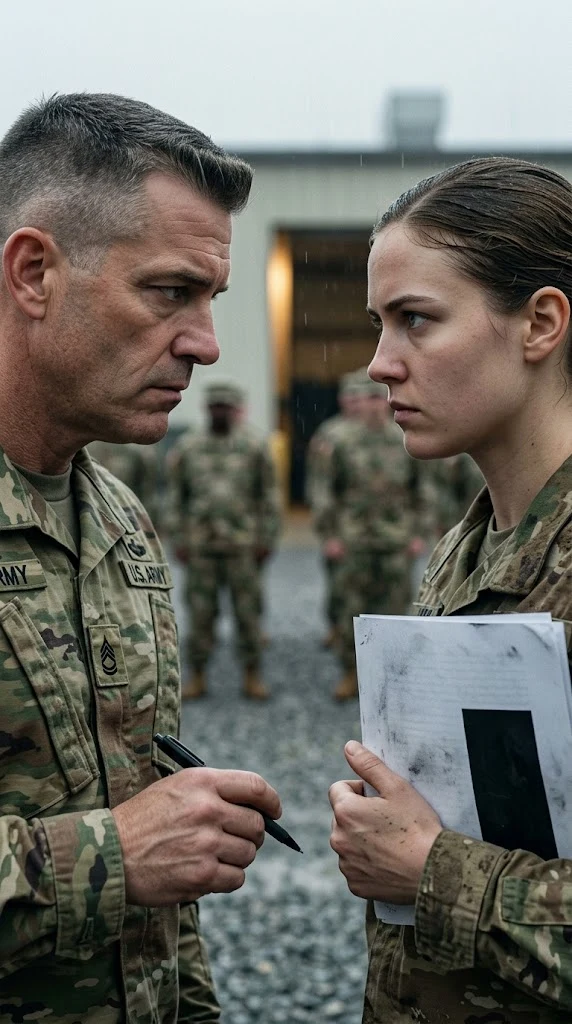
"Sign it. You lost the packet." First Sergeant Briggs held the pen out in the middle of formation, and the whole company watched Specialist Dana Whitlock look at the paper and not take it.
Fifty soldiers stood at parade rest on the gravel motor pool apron at Fort Renner, boots squared, hands frozen, nobody breathing loud. Pre-inspection, five forty-five on a gray Wednesday, drizzle still hanging in the air after two days of rain. And in the open line between first and second platoon, the first sergeant of the company was holding a sworn statement and a black pen six inches from a specialist's chest.
Dana Whitlock was twenty-six, a supply clerk, twelve months on the motor pool, the newest name the company knew — and the name it knew only as "the problem kid." She'd been flagged twice. Late with a report she'd actually filed early. Marked for an inspection she'd asked to be inspected on. Kids at the bottom of a formation learn quickly what kind of attention survives the winter.
What she hadn't told anyone was that five weeks ago she'd walked a complaint into the inspector general's office about this exact company. Nine days past due on a claim that should have been processed in three. Paperwork that didn't match the duty log. She'd sent it and gone back to work, and told herself the system would do its job.
Now the system was standing in front of her with a pen.
A maintenance packet had gone missing six weeks ago. Every soldier in formation knew the phrase by now: the packet, the loss, the investigation. It had been mentioned in four safety briefings and one Article 15 threat briefing, and every single time, the story ended the same way — clerical error, supply Specialist Whitlock, accountability.
Except Dana hadn't lost it. She knew exactly where it had gone. She just didn't know yet that she could prove it.
"Read it out loud," Briggs said, and his voice carried the way years in formations teach a voice to carry. "So the company hears you own it."
Dana looked at the paper. Her eyes went down the way they always did — strangers assumed it was surrender. It wasn't surrender. It was a shield. She read the statement twice, once with her eyes and once with her heartbeat, and both readings came back the same: sign this, and the loss is closed. Sign this, and her complaint dies in a drawer with her name on it.
She refused the pen. Just a small turn of the wrist, a half-step back, a "No, First Sergeant."
You could hear the formation absorb it. Fifty soldiers inhaling at once.
Briggs smiled the way he smiled — teeth a little too wide, like happy talk with a hinge in it. "You sign, or your record takes the flag," he said. And then, quieter, closer, the part the formation wasn't supposed to hear: "Article 15 before the inspection boards even open. You understand what that does to a specialist?"
Here's the thing Dana had said nothing about for six weeks: the missing packet wasn't paperwork for the sake of paperwork. It was the maintenance record backing a soldier's medical claim. A rollover, six weeks back, a vehicle that ended up on its roof. The packet that vanished was the packet that proved what the vehicle did and didn't have wrong with it — and without it, the soldier riding in that seat couldn't finish his claim. His claim. Not Dana's. A soldier's spine.
She said it out loud, in front of everyone. "The packet you want me to confess to losing is Sergeant Ambrose's medical claim."
The formation didn't move. The drizzle didn't move. Somewhere in the maintenance bay behind them a compressor hummed like it was the only thing in the world keeping its opinion.
And then Dana noticed something she'd dismissed for weeks. Briggs had never once asked to see her receipt book. A supply clerk keeps carbon copies of every hand-receipt — obsessive about it, everyone said. First Sergeant Briggs, who counted every pen on the CQ desk, had never looked at her book once. He'd gone to the shred bin instead. She'd seen him there twice.
That's when the old voice spoke — Sergeant First Class Gibbs, the maintenance NCO who had never once been heard in a formation in anyone's memory, the lean gray man everyone assumed was Briggs's shadow because he stood where Briggs pointed and said nothing. He was leaning against the bay wall one pace behind Dana's shoulder, and he spoke exactly loud enough for the front row to carry the rest. "You had it first, Ramsey," he said. "Rock it."
Briggs's head turned maybe three degrees. That was all it took. The shadow had never been his. It had been standing next to Dana the whole time, waiting to see if she'd break first.
Which is when she moved her left hand to her wrist — the fabric wrist-sleeve she wore under her sleeve cuff that everyone had taken for a sweatband — and folded out one smudged page.
A carbon. Dated six weeks back. A transfer signature block for the missing packet, signed out of the cage, with the initials and the name of the man who had signed for it and never turned it back in. Who had, in fact, walked it to the shred bin the same week Dana's IG complaint landed. His signature. His date. His initials, big enough to read from the second row.
She raised it to eye level, arm straight, toward the formation, and held it.
"That's… that's the carbon," Briggs said. And his jaw, the slung hard jaw that had carried every formation for two years, went loose.
"Your own initials, First Sergeant," Dana said, loud enough to reach the last rank. "You signed it out."
The pen was still in his hand. Nobody would ever remember that. What they would remember was fifty soldiers turning their eyes off the problem kid in the front and onto the man holding the pen, and not one of them stepping toward him.
Gibbs was already walking toward the parking lot, carbon in his hand, headed somewhere with a mailbox before first formation. The board would meet. Briggs would be under review by Friday — under review, nothing more, not yet, not clean and not complete.
But the carbon trail didn't stop at a shredded packet. It ran straight back to the rollover itself — the "accident" Briggs had signed off on six weeks ago, the one sentence Gibbs had never been free to say out loud.
If you want to see what else that carbon trail proves about the rollover — and whether Ambrose's claim gets its answer before the board moves first — tell me in the comments and follow the link below for the full story.
Advertisement