The First Sergeant Shoved Me at Formation — Then I Unfolded the Page He Shredded
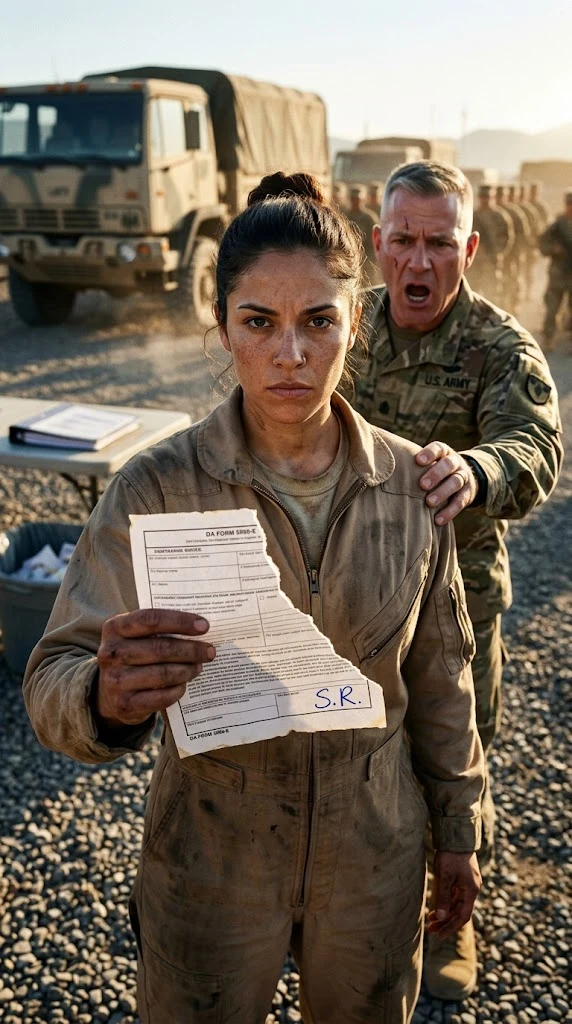
"Your signature took out those brakes, Reyes."
His open palm hit my shoulder before I could open my mouth, and three hundred soldiers watched me rock back into the ops table.
0715. Motor pool 4. Convoy inspection formation, and every single soldier in the company was watching First Sergeant Hallet decide my career with one hand.
"Article Fifteen and a chapter flag. Today." He said it the way he says everything — calm, narrow-eyed, already certain.
Four truck brakes failed. Somebody had to be guilty, and the brand-new mechanic with eleven weeks in the unit was the easiest somebody on the lot.
I didn't argue. People noticed that. PFC Lane laughed from the third row to stay in with the cool kids, and Cox grinned like it was his birthday.
"Nobody even saw you sign the log," Lane called out.
And here's the thing — nobody had said a signature was missing. Not yet. He brought it up all by himself.
I stood there with my back against the table edge, jaw tight, one arm pinned against my chest. Hallet thought the silence was guilt. Everyone did.
He had no idea what was pinned inside my jacket.
Here's what the company didn't know. At 0400 that morning, my roommate — a records clerk who was "transferring" — stood at the free printer in the CQ area making one copy of one duty-log page. Not stealing. Copying. The original went somewhere official. The copy went into my coveralls.
At 0647, I walked past fleet ops. The shred bin sat there bulging — the same bin that is ALWAYS emptied after inspections. Always. That morning, it sat there unemptied, with a corner of a page sticking out that matched the copy already inside my jacket.
I'm not the one who shredded it. I want to be crystal clear about that. I just refused to let a shredder decide my future.
Hallet leaned in close enough that I could smell his coffee. "You know what happens to soldiers who kill brakes on a convoy truck?"
I know what happens to soldiers who say nothing. They get mailed out as the scapegoat and everyone at the motor pool tells the story for years with the ending they were handed.
So I did the only thing left.
I reached into my coveralls — slow, so nobody could call it a weapon — and pulled out a torn half-page of photocopied DA Form 5988-E. I flattened it against his own laminated maintenance binder, right on the table, and held it there.
"Fished it out of your own shred bin this morning."
The motor pool went so quiet I could hear the heat shimmer off the graded gravel.
Hallet looked down at the page. His own bold blue initials, in his own blue pen, in the corner of the failed-brakes packet he had publicly blamed me for. The packet he was supposed to have shredded.
"Whose initials are those—"
His voice didn't finish the sentence.
"Yours. Blue pen. On my brakes packet."
Cox's grin died first. Then Lane — the one who laughed — went pale, because Lane had taken a photo of that shred bin at 0647. The photo showing the time. The bin. And the 1SG's own arm reaching into it.
The loudmouth was never the problem. He was the shield. The signature on the failure was always Hallet's — the man who signed the unsafe vehicle move himself, shredded the proof, and just needed me quiet while he performed my guilt in front of the whole company.
Then the maintenance tent flap moved.
A colonel stepped out. He had been inside the whole time. He held out his hand, and I placed the torn copy in it, right next to Lane's phone with the recorded file.
Hallet was relieved of the inspection on the spot. They walked him down the row of trucks while the entire formation watched, carrying a packet that still showed the ragged edge where the original had been torn.
The convoy leaves at 1100. His office is already empty and his shredder still smells warm.
And nobody has said a word about what Lane's photo actually caught — or why the colonel's face, when he saw the time stamp, looked like a man who has been waiting for this exact morning.
Follow the link in the first comment to find out what the shred bin held when the investigators arrived — and the price PFC Lane paid for the photo that saved me.
Advertisement