He Slapped My Chow Tray Out of My Hands, Then I Pointed at the Camera Bolted Above His Head
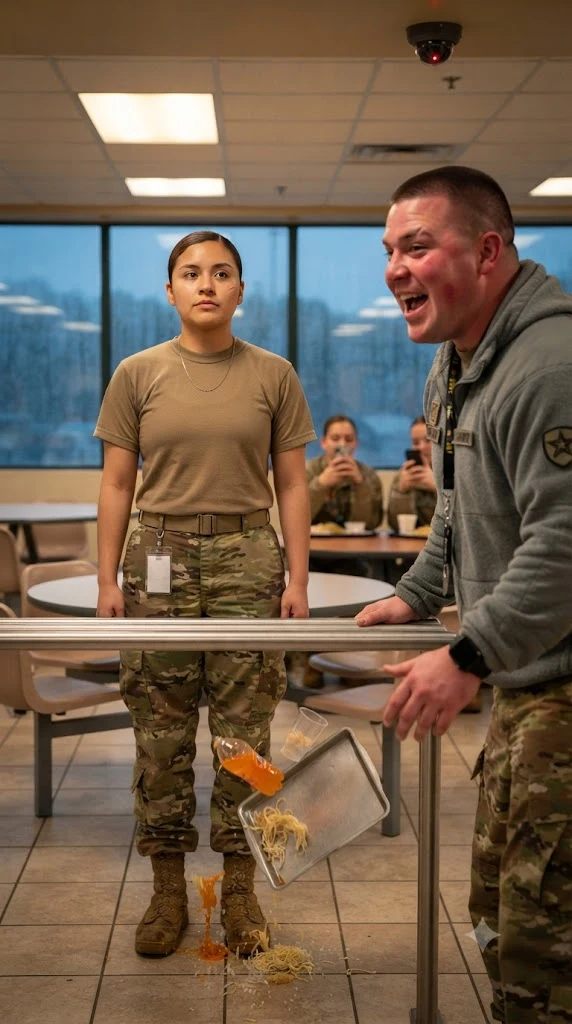
"Careful, sweetheart — this isn't your platoon's cafeteria."
The tray hit the tile and orange soda sprayed across Specialist Nia Calderon's boots. Sergeant Bruno Osteen laughed so hard he had to brace a hand on the tray rail. His squad laughed with him. Three of them already had their phones up, recording, because that's what you do when the squad enforcer picks a target.
Nia didn't move.
She didn't kneel for the tray. She didn't cry. She didn't look at his face, or his friends, or the fifty-odd off-duty soldiers who had all turned to watch a brand-new transfer get broken in on day two at a base where she knew nobody.
She just stood there with her boots wet and her jaw set, and she looked up.
Not at him. Above him.
If you've ever been the new person in a room full of people who already decided what you are, you know that split second. The one where you choose between matching his volume or swallowing it. Nia had already made that choice before he ever touched her tray — because she'd clocked the small black dome bolted to the ceiling directly over his head the second she walked in, and she'd clocked the red LED blinking slow beside it.
She knew what that light meant.
Osteen didn't.
"Say something," he said, stepping into her space so the whole food court could hear. "Go on. Say it loud so everybody hears how the new girl talks to a sergeant."
Nia looked at him the way you look at weather. Then she said one quiet sentence, at normal volume, so only the first two tables heard it:
"It's already recorded."
Nobody understood it. His squad laughed harder — one of them actually mocked her voice back at her, high and whiny, and got a fist bump for it. Osteen's cheeks went red the way they do when a joke doesn't land the way he planned, and that's when he made his second mistake of the evening.
He grabbed the collar of her jacket.
Not hard. Not enough to hurt her. Just enough to pull her half a step forward and make her look small in front of his audience, which was the entire point, and which is also the exact moment the night stopped belonging to him.
Because at the corner table by the window, a man in a civilian jacket and tactical boots had already set down his coffee.
Master Sergeant Otis Bayard had been sitting there since 6:00 p.m. with a tablet propped against his cup, angled toward the tray-return rail, and he had not looked up once during the confrontation — not because he wasn't watching, but because he was watching the screen instead of the room.
He tapped it twice and stood up.
Nobody noticed him at first. That's the thing about real authority — it doesn't announce itself. It just starts walking, and the noise around it dies in a circle, table by table, until the loudest man in the room turns around and finds out he's not the loudest man in the room.
Osteen let go of her collar when he saw who it was. His smile stayed on for about a half-second longer than his confidence did.
"Sergeant," Bayard said. Just that. One word, flat as a door closing.
"Sir, we're just —" Osteen started, and gestured at Nia like she was something spilled. "You saw what happened."
"I did," Bayard said. "I saw it twice."
He turned the tablet around.
The screen was half-full of the food court ceiling — that's what a wall camera sees first, the tiles and the light fixtures and the top of everyone's head — and then it tilted down the way the angle really looks from up there, and there he was. Osteen, mid-swing, his palm flat and his mouth wide open, caught from behind and above, and across the bottom of the frame a timestamp ticked forward in white digits: 18:14.
Nia, kneeling in the recording, small in the corner of the shot, not flinching.
The squad's phones were all still up. Every single one. You could see them in the tablet footage too — four screens tilted toward the scene, four little rectangles of light held by four men who thought they were documenting a joke.
The footage was already official. Which meant their phones were already evidence.
Nobody had to say it out loud. You could watch it land on them one at a time, the way cold water lands on skin. The guy who'd mocked her voice lowered his phone first and put it face-down on his tray like it had gotten hot.
Bayard pulled the tablet back and spoke to Osteen without raising his voice at all: "Step away from the rail. Hands where I can see them."
Osteen's mouth opened. Closed. He glanced left, at his squad, looking for the laugh to come back, and found seven faces that had decided, very quickly and very quietly, that they had never met him.
One of them — the kid who'd fist-bumped a minute ago — picked up Nia's tray off the floor and set it back on the rail without being asked. He didn't look at her. He didn't have to.
That's when the base MP appeared at the door in the front corridor, and Bayard lifted two fingers off his belt in a small, unhurried wave, the way you'd signal a waiter, and the MP started walking in.
Osteen saw the uniform and his whole body changed. His shoulders dropped. His hands came up slightly, palms out, not surrendering so much as explaining — and you could feel the whole food court lean in, because this was the part everyone wanted. Not the humiliation. The aftermath. Would he yell? Would he beg? Would he try to drag his squad down with him?
He did something worse. He went quiet, and he started talking fast and low, aimed only at Bayard, the words sliding under the room's noise where nobody could hear them — and whatever he was saying, you could watch Bayard's face while he said it. Steady. Not angry. Not persuaded. A man reading a form he'd already filled out.
Then Bayard turned the tablet one more time, just slightly, so Osteen could see the part he'd missed the first time: the corner of the frame above the tray rail, where the small black camera dome sat with its red light still breathing, slow and patient, and a little strip of data underneath that showed when the recording had started.
18:00.
Fourteen minutes before Osteen ever touched her tray.
He'd walked into the food court that evening and picked a target in a room that had already been watching him since before the chow line opened. And the worst part — the part that will stay with you — is that he wasn't even the one who requested the upgrade. That form came from inside his own squad, three weeks ago, one day after a different female soldier filed something that went nowhere.
He's being walked out now, past the rail, past the tray, past the squad that used to laugh at whatever he laughed at. He hasn't looked at Nia once. He won't. He's looking down the corridor at a breakroom door that just opened, and standing in it is his own squad leader, who has been watching the live feed this entire time and has not said a single word.
I'll put the rest in the link below — what Bayard found on the second file, and what the squad leader was waiting for.
Follow for the full story.
Advertisement