The Hospital VP Called the Night-Shift Tech a Thief in Front of Everyone — Then She Slid a Photograph Across the Table
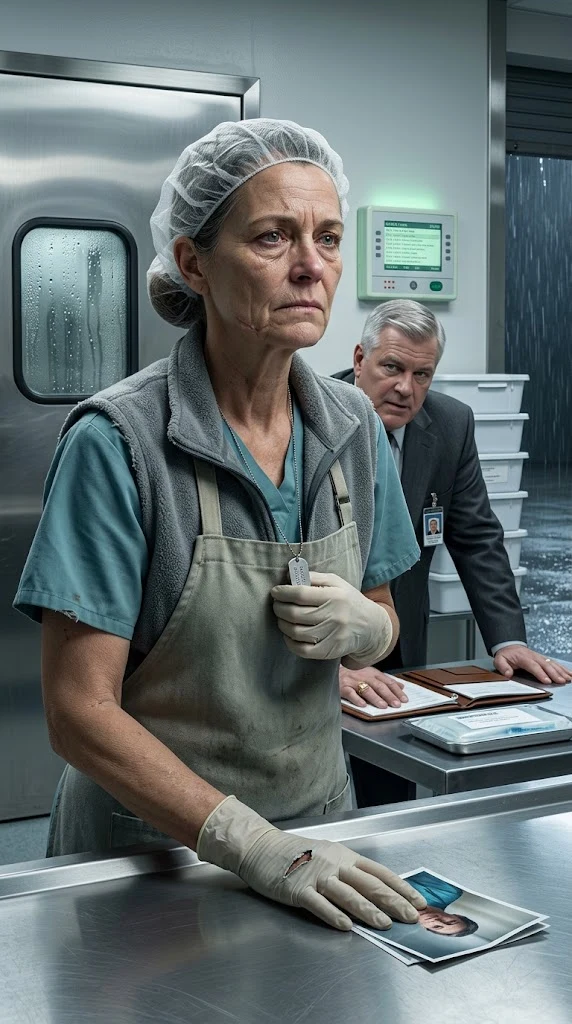
"She's done here — that tray came out of her cart, and the whole night shift saw it."
Gerald Ashby said it with both palms flat on the steel table beside her, loud enough to carry down the corridor past the nurses' station.
My mother has worked sterile processing at this hospital for eleven years on a contract with no union and no badge tier. Most of the staff know her by cart number. Nobody in that hallway knows her first name.
She didn't argue. She's never argued with anyone in her life.
I'm Dr. Elise Marchetti-Reyes, chief operating officer of this hospital system, and I was standing twenty feet away when my senior vice president of operations publicly accused a fifty-eight-year-old woman of stealing from a locked narcotics cabinet.
I hadn't slept. I'd been in the records office until midnight again, pulling old adoption files for the third time that month, trying to trace a medical history before a surgery I'd put off twice. My mother died when I was an infant — that's what the sealed file said. That's what I'd been told for thirty-one years.
So when I walked onto that dock at 2:40 a.m. and saw Ashby with his folio open, badge log printed, pointing at the bin number, everything in me said: he's doing his job. He's the only one in this building who reads the logs.
That's the part I want you to sit with.
I believed him.
He slid the printed badge log across the table. Cabinet accessed at 1:12 a.m. Tray count missing. Bin number matched the cart she'd been assigned that night. Clean, procedural, calm — the voice he uses in board meetings.
"Do you want to call security, or should I?" he asked me.
And that's when I noticed the seal.
The instrument tray sitting on the table between them had wet condensation beading on the inner wrap. Autoclave trays don't sweat two hours after they leave the cabinet. They sweat minutes after.
"Mr. Ashby," I said, "why does the seal have condensation on it if that tray left the cabinet at 1:12?"
He blinked once. Just once. Then he started explaining cycle times, humidity, the dock door being open in the rain — and the explanation ran long, and every word of it was the kind of thing you say when you're stalling.
Ruth Ann Vossler — that's her name, and I had to pull it off a supply log to learn it — hadn't said a single word. Her right glove had a tear across the palm. I checked the shift log later. She'd requested a new pair twice that night and been told to wait.
She reached into her apron pocket, took out a folded photograph, and set it on the steel table between us. Then she slid it toward me with two fingers, face down, without saying anything at all.
The back had handwriting on it in blue-black ink. Nurse's ink. The same shade and the same slant as the entries on my own adoption intake record — the one I'd been staring at for three weeks.
I turned it over.
A woman in a hospital bed, thirty-one years ago, in this hospital. A newborn in her arms. And standing beside the bed, younger, heavier, gold signet ring on his hand, smiling down at the baby —
Gerald Ashby.
The handwritten line on the back read: "Mother refused discharge. Child placed. Do not contact."
I've read that handwriting eleven times since. I'll read it a thousand more.
Because the woman in that bed is the woman standing in front of me in a hairnet with a torn glove and a cart she pushes for $14.60 an hour. And the man who signed her away has been my senior vice president of operations for eleven years — the man who transferred her onto night shift eleven months ago when I started reviewing old records.
He didn't fire her when she became a risk. He hired her. Kept her close. Watched her.
"Turn around," I told him.
The badge reader screen on the nurse call panel was still glowing behind us. His access tier, his badge number, his timestamp — 1:12 a.m., the exact minute the cabinet opened. The log he'd handed me was a reprint. The screen on the panel was live.
He said my name then. Soft. Like we were colleagues. Like he hadn't buried a living woman in my own filing system.
"Your grandmother hired her," he said. "She wanted the child raised properly. I only kept the paperwork."
Only.
That's the word I keep coming back to. Only.
He wasn't finished. "The trust paid the records clerk. Ask her. She's still here — she's your compliance director now."
Then Ruth Ann spoke for the first time all night. Quiet. Steady. No tears. She'd been holding it in for three decades and she still wouldn't let him see her break.
"Gerald," she said, "tell her what year you stopped sending the money."
He didn't answer.
If I tell you what happened in that corridor in the next ten minutes, I'll ruin it. What I will tell you is that my mother is asleep in my guest room right now with a hospital blanket over her, and I am sitting at my own kitchen table at 5 a.m. holding the second entry in the family trust ledger — a payment dated thirty-one years ago, paid to a records clerk, signed by my late grandmother, with a memo line that says nothing at all.
There's a third name on that ledger I haven't recognized yet. I'm calling the compliance director at seven.
Full story in the link below — who signed it, what the trust bought, and what my mother whispered when I finally asked her why she never came looking for me. 👇
Advertisement