The Judge Had the Barefoot Girl Seized in Her Courtroom — Then the Child Slapped a Sealed File Onto the Bench Bearing the Judge's Own Signature
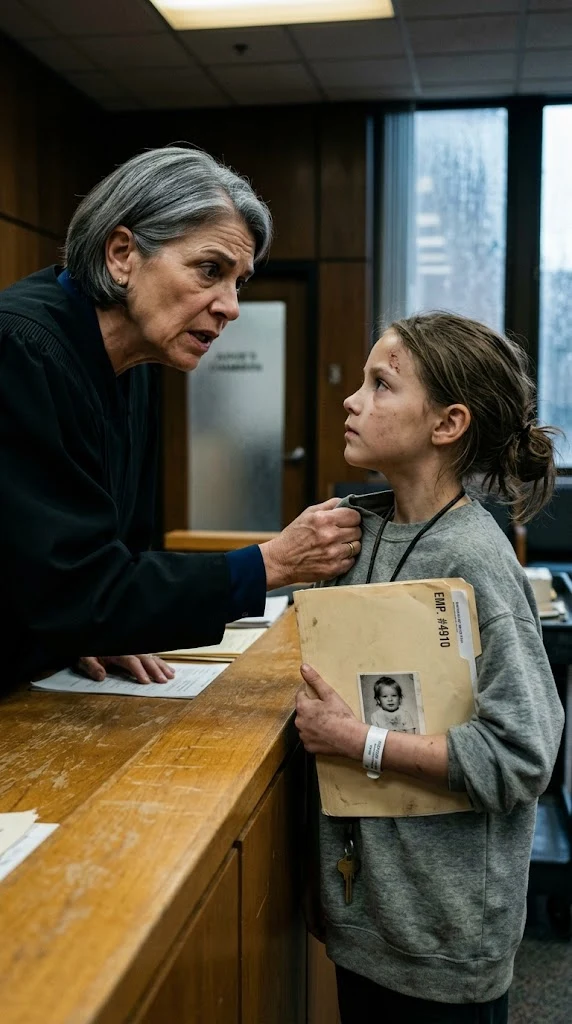
"Judge Vantry — your son lied to you," the girl shouted — and the bailiff's hand closed around her collar before she finished the sentence.
She was eleven years old. Barefoot on rain-slick marble, one sneaker tied to her belt loop, her fingers locked around a court-stamped folder like it was made of glass.
Judge Marisol Vantry didn't look up from the bench. "Get her out of my courtroom."
Deputy Bailiff Odell Pratt pulled. The girl's heels skidded across the floor. She didn't cry. She didn't beg. She turned her face sideways against the grip and said it again, louder, so the court reporter's fingers stopped moving.
"Judge Vantry — your son lied to you."
The room went very quiet.
Marisol Vantry has worn a robe for twenty-nine years. She has run the juvenile division of Cook County for nine of them. She has been called ice across the bench, and she earned it. When her only son Peter died eleven months ago — forty-one years old, in a rehab bed in Naperville, with the family still telling people it was an accident of genetics — she came back to work in nine days and heard forty-one cases in the next month. She did not take a single afternoon off. Grief, for her, was something you scheduled after the docket.
Eleven months. That's how long she'd been feeding her dead son's memory a clean bowl.
And now this child.
Junie Barlow was her name. Protective services had a number for her instead of a parent. She'd been found sleeping in a laundromat on the west side nine weeks ago, then vanished from the system, then reappeared in a Cook County third-floor hallway during a routine disposition hearing that had nothing to do with her, three floors below a newsroom full of reporters covering a corruption scandal in a different department entirely.
She smelled like bus seats and rain. She had a hospital wristband on her left arm — cut, not removed, still hanging open like a cuff — and a brass key on a leather shoelace around her neck that swung against her collarbone every time the bailiff moved her.
The judge's voice was flat. "She stole a sealed court document. That's a felony, Deputy Pratt. Call intake."
Pratt didn't move right away. That was the first thing that broke the afternoon, and nobody noticed it yet.
Because Junie's eyes weren't on the judge. They were on the frosted glass panels of the chamber door behind the bench — the door that had been closed all morning, the door Marisol Vantry hadn't opened since she came in at noon.
"There's a man in there," Junie said.
"You're going to state custody," the judge said. "My phone call ends your mother's case tonight."
That was meant to land. It was meant to break the girl, the way it had broken a hundred kids before her.
Junie's face didn't move.
"My mother's dead," she said. "She died Sunday."
Nobody spoke. Pratt's hand went slack on the collar by exactly one finger, and Junie felt it and stepped out of the gap, and that's when she walked — not ran, walked — to the bench, on her own two bare feet, while every adult in the room stood frozen watching her.
She laid the folder flat on the laminate and opened it.
"Open it. Look at the bottom," she said.
Marisol Vantry did not want to look. That is the part nobody ever tells you about moments like this — that there is a half-second where you already know, where the animal part of you smells it, and you still have the choice to pretend you don't.
She looked.
A photograph of a two-year-old girl. Blonde. Chubby hands. An intake page from the Cook County Juvenile Division, dated fifteen years back, the year Marisol Vantry made Deputy Chief.
And across the bottom margin, in blue-black ink, a signature she had written ten thousand times on ten thousand documents in her own handwriting, under a case number she had never once opened.
"That's your handwriting, Your Honor," Junie said, and she said it quietly, the way you tell someone their house is on fire — no joy in it, no cruelty, just the fact.
The court reporter's pen had stopped somewhere around "your son lied to you" and never started again.
Marisol Vantry stood very still. Her right hand came down on the bench beside the file — not a slam. A placement. Fingers spread flat, like she needed the wood to stay upright.
"I sealed this," she said.
"Yes," Junie said.
"I sat on the bench and I sealed this case."
"You signed it away," Junie said. "You signed me away."
Here is what Marisol Vantry thought she understood in that moment. She thought Junie was Peter's daughter — that her son, alive in some apartment or halfway house, had fathered this child and abandoned her, and that this folder was the proof, and that the whole afternoon was going to end with her on the floor of her own courtroom holding her dead boy's secret child.
She was wrong. She was wrong in a way that saved her and ruined her at the same time.
Because Junie wasn't Peter's daughter. Junie wasn't family at all. Junie's mother — the woman who died Sunday, the woman whose body was still in a Rockford morgue waiting on a county burial — was a foster mother named Corinne Barlow, and Corinne had spent four years quietly collecting what the state had dropped, and two weeks before her death she had gotten inside an evidence room and taken back the one folder that could not be argued with.
The file wasn't about a lost child. The file was a routing sheet.
It listed placements. Sixteen of them across Cook County over three years. Falsified home studies. Children moved out of the system into homes that had no business being licensed. And at the bottom, beneath every case number, two signatures: the intake clerk's, and a routing consultant's — Peter Vantry's, written in his fast slanted hand, the same hand that had written his mother a birthday card eleven months ago that she still kept in her desk drawer.
Her son was not a victim of the network.
Her son was the routing clerk who kept it running.
And her seal — the seal she had signed without reading the transcript, because it was 4:40 p.m. on a Friday and she had three more files and a grandson's birthday dinner — that seal had locked those sixteen children out of the system's sight for fifteen years.
Which meant Junie was one of them.
Junie was one of the sixteen.
The room tilted. Marisol Vantry put her other hand on the bench and looked at this girl's face, and for the first time in twenty-nine years she saw a defendant as something other than a case.
"Pratt," she said, low. "Clear the room."
The deputy's eyebrows lifted. "Your Honor?"
"Clear it. Attorney steps out. Parent steps out. Court reporter stays and keeps taking it down. Everybody else out of this courtroom now."
They went. The doors closed. The rain kept moving down the west windows, loud and indifferent, and in the emptiness the judge looked at the eleven-year-old and asked the question that had been waiting there the whole time.
"What did your mother tell you to do with this?"
Junie reached into the front pocket of the oversized gray sweatshirt she'd been wearing for eleven days straight and pulled out a folded index card, softened at the creases from being held in a fist.
"Hand it to nobody but her," Junie said. "She wrote that. She knew she wasn't gonna make it. She wrote this for the judge who signed the paper."
Marisol Vantry opened the card. Four lines in small round handwriting. The first line was a name — the name of a man who was still alive, still working, still walking these halls. The second line was an address. The third line was the word she was not prepared to read.
The fourth line said: *He knows the other half is missing. Don't let her out of your sight.*
The judge looked up.
"What man?" she said.
Junie didn't answer with words. She turned her head — slowly, all the way — toward the frosted glass panels of the chamber door behind the bench, and stared at the shape there, and Marisol Vantry's eyes followed hers and landed on what had been sitting there the entire hearing.
A silhouette. Motionless. A shoulder, a collar, the edge of a head, held still enough that it had been invisible until somebody named it.
"He came in at twelve-forty," Junie said. "I saw his shoes."
Marisol Vantry pushed her chair back. The scrap of it on the marble went through the room like a small scream. She crossed to the chamber door and put her hand on the brass knob, and she tried it, and she tried it again — and it didn't turn. Locked. From the inside.
Her own office. Her own door.
Behind her, Deputy Pratt had come back in without a word because he'd heard the chair, and he was standing in the doorway with his hand on his radio, watching the judge's face go from grief to something colder and more dangerous than either of them had seen on her before.
"Your Honor," he said carefully. "That door's been locked since you came in."
"I know," Marisol Vantry said.
And she did the math out loud, quietly, so the court reporter could take it down: someone had been inside her chambers for three hours while a runaway girl bled through an evidence folder on her bench, and the second half of that file — the half with the names of sixteen children and every placement address — was either sitting behind that glass or already gone.
Junie picked up her folder. Two bare feet. One key on a shoelace, swinging.
"I'm not scared of him," she said. "I'm scared of what's in the box."
The judge looked at the little girl.
For twenty-nine years she had ended every matter on her docket with a strike of a gavel. She had never once apologized from the bench. Not to a defendant, not to a family, not to anyone.
She knelt down in front of Junie Barlow on the courtroom floor, in front of the deputy and the stenographer, and she said it out loud:
"I sealed the case that put you in the hands of the people who sold you. I did not read it. That is not a defense. It is the whole crime."
Junie did not say thank you. Junie did not hug her. Junie looked at her the way children look at adults when they have stopped expecting anything, and she asked the only question that mattered to her anymore.
"Then who do I give this to?"
Marisol Vantry stood up, and her hand closed around the folder — and the girl, in the same motion, handed it over. The seal on the spine caught the gray window light. Her employee number looked back at her like a date.
"There are sixteen addresses in this city with children on them right now," the judge said. "Every one of them is on the page your mother died holding."
Somewhere behind her, through the frosted glass, the silhouette shifted its weight. One small movement. A floorboard, a chair, a person deciding something.
The judge didn't turn around.
Junie did.
And that is where it stops — right where the girl's face turns, and the shadow behind the glass turns with her, and a door that has been locked for three hours is about to be the center of a courtroom again.
One of them is about to open that door.
The other one isn't walking away.
**If you want the moment the chamber door opens — the name of the man behind the frosted glass, the sixteen addresses, and what happened to Junie by six o'clock that night — the full story is at the link below. It's long, it's ugly, and the second half of that folder changes everything.**
Advertisement