The Mess Hall Fell Silent When the Four-Star General Knelt Before the Scarred Woman
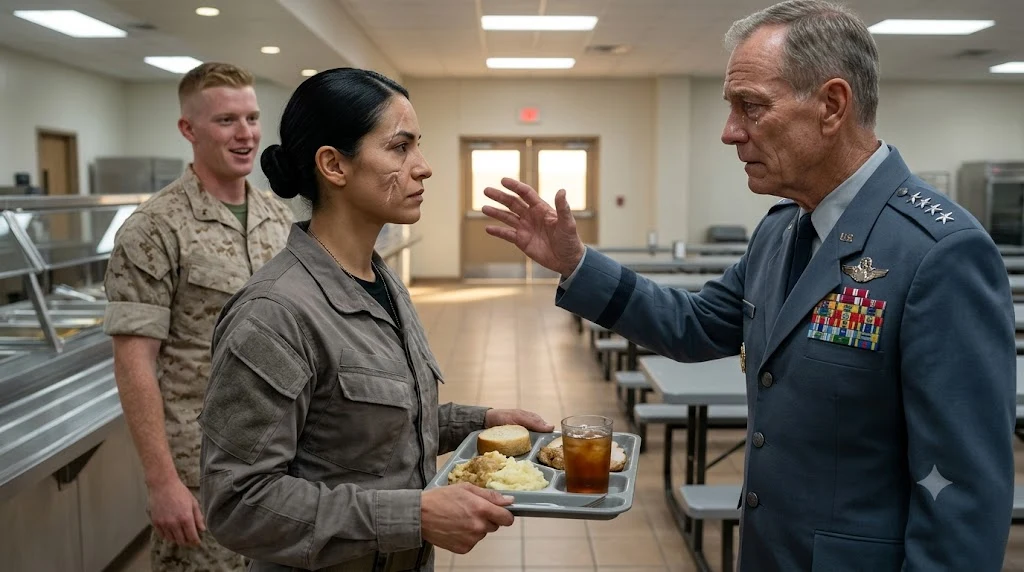
"Halloween's early. Cover that face up."
The spoon hit the tray and nobody picked it up. Every Marine in that Nellis mess hall turned to look at the woman at the serving line, and Dalton Kersey stood behind her left shoulder with his grin already wide, waiting for the room to laugh with him.
Iris Calderon has thirty days of leave left before her file gets reviewed, and the one thing her work depends on is that nobody in this building ever connects her face to a name.
Her fatigues had no name tape. No rank. Boots still gray with dust from a country that appears on no record, and a white scar running from her left temple down across her eyebrow to the corner of her mouth. She held her tray with both hands and did not turn around.
Kersey flicked one hand toward her face without touching it. "You hear me? This is a chow hall, not a haunted house."
A Marine to his right laughed. Then a second one. Then two more behind the serving counter.
She set her tray down on the stainless rail, slow, like a woman with all day. "Step aside, Marine."
That flat rasp of a voice — smoke-cooked, low, no shake in it — landed wrong on him. He stepped in closer, chewed his gum twice, and gave the room what it wanted. "Or what? No tape, no rank. You're nobody."
Three trays clicked down at the tables. Someone whispered it down the line, and the whisper came back bigger.
She looked at him the way an adult looks at a loud child, and that was the exact second the far double doors opened.
Desert light came through them first. Then the shadow. Then every man in the hall stood up at once, chairs scraping, boots together, and Kersey's mouth stopped moving mid-sentence because he already knew who it was without turning — the sunlight on cordovan shoes, and the four stars on each shoulder of the blue-gray service dress, walking straight down the center aisle.
General Wade Hunsaker. Fifty-eight. Thick-necked, iron-gray crop, weathered face, hands that had signed more letters than Kersey had years.
Kersey snapped to attention and talked first, fast, the way a man talks when he thinks he is being promoted by the moment. "Sir, I was just handling a civilian, she came in off the street, I was maintaining standards on the line—"
The general did not look at him. Not once. He walked past the boy like the boy was furniture, stopped in front of Calderon, and the whole room watched a four-star general's hand start to tremble.
"Sir," Kersey tried again behind him, "I was just—"
Hunsaker raised one open hand toward her face and stopped an inch short of her scar. He never touched it. His breath came out of him in one broken piece, and what he said next was a name, not a rank, not a greeting, not an order.
"Iris. I thought you were dead."
The tray hit the floor. Mash across the tan tile, the metal ringing off the legs of the counter, and the sound went through that hall like a gunshot in a church.
Nobody moved. Kersey stepped back one pace and his boot heel found the support column and his shoulder blades pinned against it and stayed there. His gum stopped. His smirk was gone and he was looking at the floor tiles like a man reading his own paperwork.
Two MPs came in through the doors behind the general and did not need to be told where to stand. They stood one on each side of Kersey, and he shrank between them — the loudest man in the room ten seconds ago, now the smallest object in it.
Ruth Delgado, seated at the far right end of the hall with the closed logbook on her lap and the folded gray blanket over her knees, watched the whole thing without blinking and wrote nothing. She would not need to.
Iris Calderon stood center frame with her chin level, tray gone, boots dusted, and she was the only person in that building still able to speak.
I'll tell you what happened in the unnamed country, why the general personally extracted her from a burning refinery, and why he signed a letter he should never have signed. The whole file is in the first comment. Read it, then tell me one thing — if you had been standing at that line, would you have kept your tray steady the way she did?
Advertisement