My Brother Accused My Eight-Year-Old Daughter of Stealing His Watch at His Wedding, So I Slapped Him and Held Up the Receipt
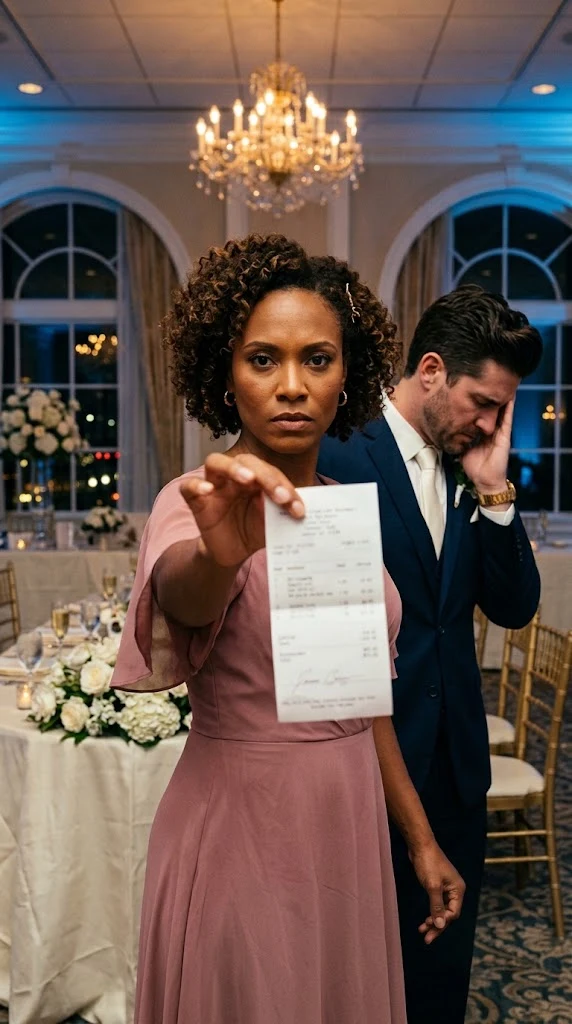
My brother grabbed my eight-year-old daughter's wrist at his own wedding reception and told three hundred guests she was a thief. I had ten seconds to decide whether to pull her away or pull his hand off her — and I chose the slap.
The music had stopped. The cake was already cut. Every champagne flute at the head table was still full.
Amara was in the children's section at the back of the room. Her shoes were lined up under a folding chair. Her bracelet was on the floor near Dylan's place setting. Nobody had asked her a single question before he crossed the ballroom.
"You know what she did," he said. Not to me. To the room. "She took my watch. Search her."
Three hundred people. White roses. A band waiting on a downbeat that never came.
I did the arithmetic in my head the way I do when a student is lying to me. One: my daughter was seated thirty feet from the head table the entire reception. Two: my brother had been touching his right wrist all night, and the watch on it did not sit the way his old one sat. Three: our mother was staring at her plate instead of at her son.
I told him to let go of her. He told me she was a thief and everyone saw her. I was still holding her arm. My clutch was in my other hand.
So I used the hand I had free.
The slap made a sound the band heard from the loading dock. Dylan stepped back one pace and put his palm to his cheek, and I remember thinking how young he looked doing it.
My mother was at my elbow before I could breathe. "Not here," she said. "Renee, not here. Apologize. Take her home. You're embarrassing the whole family."
I have thought about that sentence a hundred times since. Not *you're wrong.* Not *let her go.* **Not here.**
I said, "He called my daughter a thief in front of his guests. Where exactly should it happen?"
She went quiet. And that's when I remembered the clutch.
I bought Dylan a watch eleven years ago for his graduation — a real one, a vintage piece, the only expensive thing I have ever owned and then given away. He sold it, or said he sold it. But I kept the carbon-copy receipt from the jeweler, the kind with a copy pressed onto the back, and it was in my bag because I never trust family with family paperwork.
I opened the clasp. I pulled out the slip of paper, folded four times, edges soft.
"This watch you're wearing," I said. "Is it the one I gave you?"
He didn't answer. His jaw shifted. His new wife, Priya, was watching her father the way a kid watches a parent in a parking lot — checking the face before the body moves.
"Is it?"
"That watch was stolen," he said.
"Then explain this signature."
I turned the paper toward the table so the signatures showed. The bride's father came closer. So did his brother, and then a knot of guests from the table behind them.
I had not planned any of this. I was going to survive the wedding and drive home and let my daughter fall asleep in the car with cake on her chin.
But the receipt was in my hand, and the signature on it was not Dylan's.
The jeweler was in that room. I had seen him at cocktail hour — a small pale man with a grey mustache, an old friend of my father's. I called his name across the ballroom before I could think of a reason not to.
He came. He took the receipt. He held it under the light of the candle the table centerpiece was burning.
"That's not my hand," he said quietly. "I never signed this slip."
The room made a sound like water going out.
I should tell you what I felt then: almost nothing. Not triumph. That came later, in the lobby, with the valet. What I felt was the temperature drop, the way it does when a classroom realizes the teacher let the clock run out and no one has to take the quiz after all.
Dylan started talking fast. The words blurred — *mistake, grabbed the wrong paper, the jeweler is confused, Renee has always been dramatic.* And somewhere in that blur, Priya stood up from the bride's chair and asked her husband a question so quietly I had to read her lips to get it.
I will tell you the question, because I heard it the second time. She asked: "Did you stage this?"
He said her name. He said it like a door closing.
And then my clutch buzzed. I had put my phone on silent. It was the family group chat — but it wasn't a message. It was a forwarded voice memo. From Dylan's number. From before the wedding. Marked 4:11 p.m., two hours before the ceremony.
I have listened to that recording thirty-one times. I still flinch at the part where he laughs.
"Priya, listen," his voice says on it. "They're going to pull your dad's audit next week. If the watch goes missing tonight, we have the story in our pocket before his people even ask for the books. Nobody's going to audit the victim of a wedding theft."
A phone passed from hand to hand down the long table. The same voice memo. The same laugh. His voice, unmistakable, in a room where everyone knows how he sounds.
I want to tell you the guests turned on him all at once. They didn't. That's a thing that happens in movies. In real life, a hundred and sixty people spent the next four minutes not looking at him, and their not-looking was the loudest thing in the room.
The bride's father was the first one to walk. He crossed the ballroom floor to the banquet doors without stopping, and Priya followed him, still carrying her bouquet. Her mother went behind them. The band quietly started packing up the stands.
Then my mother stood. She is sixty-three, and in the dove grey suit she bought at a mall two towns over she stood up in front of her son's guests, and she said nothing, which was worse for him than anything I could have invented.
"Sit down, Ma," Dylan said.
She sat.
At 8:40, a man from hotel security came to the head table and asked to speak to the groom privately. Dylan went with him. He was not allowed back into the ballroom. Two of his groomsmen — fraternity friends from college — drove him home. I know this because one of them called me from the parking deck to ask where Dylan kept his spare keys.
The ballroom did what ballrooms do. Guests ordered coffee. They collected their jackets. A server started stacking plates at the table nobody had touched. The dance floor stayed empty except for one child's shoe that no one had come back for.
I found Amara by the children's table. She was sitting on the floor with a napkin folded into a triangle and a plastic cup of Sprite going flat beside her. She had one shoe. She had taken the bracelet off hours earlier because it pinched, and she had forgotten all about it — which is why it was under Dylan's chair, which is exactly how the whole thing started.
"Mommy," she said, "did I do something?"
My daughter had been sitting thirty feet from the head table the entire night. She had never touched anyone's arm at that table. She had spent the reception teaching a seven-year-old cousin how to make a paper boat. And a grown man she had known her whole life — her uncle — had walked across a ballroom and dragged her into the middle of a fight she had no part in.
"No," I said. "You did nothing."
She processed that the way she processed most things then, which means she asked the real question twelve seconds later. "Why did Uncle Dylan say I stole his watch?"
I was still holding the receipt. I folded it back along its worn seams, four times, into a small square, and slid it into the clutch next to my phone. I told her the truth as much as I could at age eight: "He was wrong."
She nodded once and let me pick her up. She smelled like frosting and sweat and the rubber smell of a balloon she had deflated on the way to the table.
The lobby of that hotel is four stories of windows with the city hanging behind them. Gold on the ceiling. A long marble counter where people wait for their cars and pretend their evening is going fine.
The valet who brought my car around is a young man named Marcus Duval — his name was on the vest, and he told me later he had recorded the circle of guests outside the doors at the valet stand, because a man had been shouting, and he was worried about the woman in the rose dress with the kid asleep against her shoulder. He had the timestamp. He offered to send me the clip.
I said send it. Not for court. For my mother.
Dylan came out of the ballroom hallway while my car was idling at the curb. He had his phone in his hand and no one beside him. His right wrist was bare — the replica gone. He stopped about twelve feet from me, near the columns, and stood there like someone waiting for a bus that had already left.
He said my name. He said it softly. He said, "You've destroyed my life."
I told him the truth, the same truth I would have told him in the driveway when we were ten: "No. You did."
I put Amara in the back seat. I buckled her belt. I closed the door as gently as I could. My hands were shaking — not with fear, with everything — and I stood at the driver's door for a long second with my forehead on the cold window and let it pass through me.
Then my mother's voice came across the lobby, urgent and small, calling my name.
I did not turn around.
I got in the car. I started the engine. In the rearview mirror I could see her in the lit doorway with her hands folded in front of her — pearls, grey suit, an embroidered handkerchief in her grip — and my brother at the colonnade with no one, and Marcus the valet watching all of it from the stand with his phone in his pocket.
Amara asked if we were going home.
I said yes. We were going home.
That was a Friday. On Sunday morning, I got a text from my mother I have not answered yet: she wants to come to my apartment. She wants to tell me something about the loans, and about what she knew. It is buried in twelve words and spelled correctly, which is more than I have gotten from her in three years.
And Priya's father called Tuesday. Not to apologize. To ask what I was willing to sign.
I'll tell you the rest in the next chapter.
**If you want to know what my mother admitted in my kitchen that Sunday — and why Priya's father needed my signature — the full story is on the blog. I don't tell it anywhere else.**
Advertisement