My Husband's "Assistant" Barred Me From My Own Foundation Wearing My Mother's Brooch — Then the Founding Architect Unrolled What My Father Signed
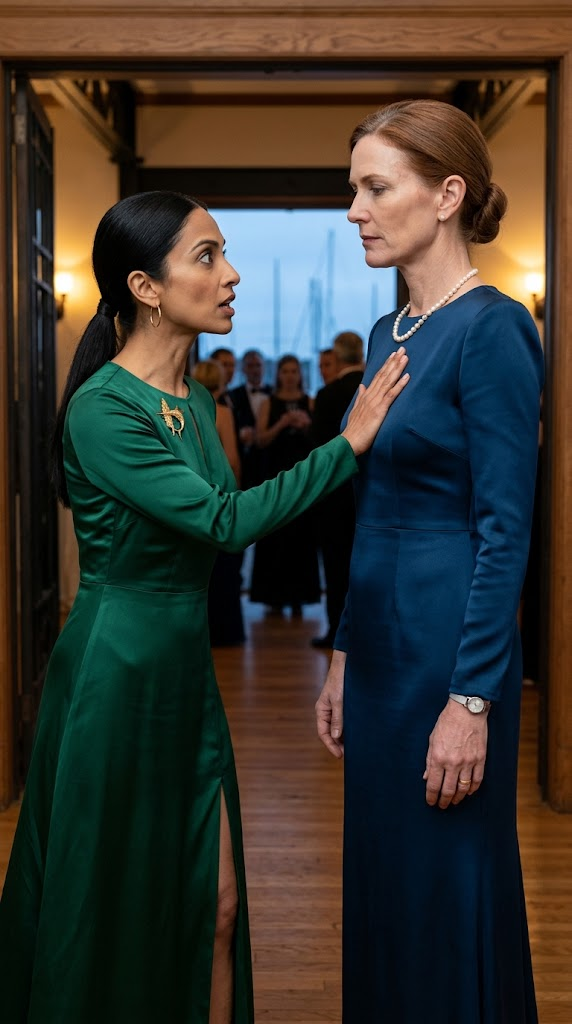
Priya put her palm flat on my sternum at the donors' door and said, loud enough for the whole receiving line, "You are not on tonight's list, Willa. Turn around before I have you removed."
She was wearing my mother's brooch.
And she said it the way a daughter of the house would.
I want to explain what it costs to stand in the doorway of a hall your own father built, in front of two hundred people who have known your face for forty years, and hear a woman eleven years younger than you say the word *removed* — as if you were a caterer who wandered in through the wrong door.
Two years ago, I was Willa Marchetti. Founding chair of the Marchetti Family Foundation. Only surviving child of Alden Marchetti, whose shipyard paid for half the churches on this shoreline. I had spent my life in that hall.
Then I got sick.
That was the word everyone used. *Sick.* I don't remember much of that first year — not honestly. I remember sleeping sixteen hours and still feeling like I hadn't slept. I remember my hands shaking so badly I couldn't sign a check. I remember a doctor with a soft voice telling me, in a careful tone, that what I was experiencing was "a natural grief response to the loss of my father," and that I should not make any major decisions for a while.
Grayson held my hand at that appointment.
He held my hand while he told my own board that I was "struggling." He held my hand while he moved his assistant into the guest suite. He held my hand while he moved her further — into the west bedroom, the one with the harbor view, the one my mother used to keep her letters in.
Priya Ashland. *Assistant.* Thirty-eight. Jet-black hair in a slick low ponytail. Walking the house in my mother's silk robes, calling the housekeeper by her first name, calling the dogs by their names before I had a chance to.
Everyone in that hall believed she was his mistress.
I believed she was his mistress.
Even the staff believed it. I heard the caterer's son say it at a Christmas party: "the future Mrs. Marchetti." I heard my own driver say it, apologetically, like he was trying to warn me about weather.
That was the story they built. A wife coming apart at the seams. A husband doing his best. A young woman moving in to help. And underneath it, quietly, patient as tide, a conservatorship.
I want that word written down where people can see it, because for months I did not use it about myself. I used softer words. *Recovery. Rest. A rough year.*
Grayson did not use soft words. On paper, filed with the State of Connecticut four months after my father's funeral, my husband petitioned to become my legal conservator. The filing described a woman — me — who was "unable to manage her affairs," "vulnerable to exploitation," and "in need of structured oversight." It was signed by a physician. It was drafted by a law firm I had never retained.
The physician was paid, in three installments, through a consulting LLC registered to Priya Ashland.
I would not learn that for another eighteen months.
For two years, my husband and his "assistant" ran my foundation. They ran it under my name. They moved the endowment through vendor accounts I did not authorize — nine shell entities, most of them incorporated in states I have never lived in, all sharing a registered agent with a fifth-floor office in Darien that held exactly one desk.
They replaced my portrait in the trustees' corridor with a photograph of the two of them cutting a ribbon in Fairfield.
They rewrote the foundation's history. Not the actual history — the *brochure* history. The website. The awards program. Two years of it. My name got shorter every season. First "Willa Marchetti, co-founder." Then "the Marchetti family." Then, on the invitation to this year's Founders' Award, the phrase *in memory of Alden Marchetti, and his successors.*
The invitation never named me.
I only found out they were giving the permanent director title to Priya when my old sailmaker's wife called me. She still got the mailings, out of habit. She read the program to me over the phone, her voice getting thinner with every line, until she got to the part about the Founders' Award being presented *by Priya Ashland, acting director,* and she had to stop.
I did not shout. I did not call a lawyer that night. I sat on my porch and watched the harbor and did something my father would have recognized: I got up the next morning, cooked myself one egg, and started, very quietly, to find out what had actually been done to me.
That took eleven months.
I want to say something to everyone who has ever been erased slowly. It does not happen with one lie. It happens with a hundred small ones, and with a room full of people who find the small lies easier to believe than the obvious truth.
So when I walked down the path to the donors' entrance on the third Saturday of September, at 7:40 in the evening, the smell of the harbor coming off the loading doors, the light already golden inside the hall, I was not there to argue. I was there to end it. And I was there because a man named Hugh Ashby, eighty-one years old, the founding architect of my father's hall, had called me the previous Tuesday and said only this:
"Willa. Be at the door on Saturday. Bring your pearls. I'll bring the ink."
Hugh had built the hall with my father in 1981. They had sat at the drawing table for a year, the two of them, and my father — who was not an architect, who could barely stay inside the lines — had personally inked a sentence into the bottom margin of the vellum. I had seen the drawing a hundred times as a child. I had never read what the sentence said because nobody ever told me it was there to read.
Hugh told me Tuesday.
Priya was standing there in emerald silk, one hand already raised the moment I came up the path. She had a donor list in the other hand. She had the brooch on.
The brooch. Let me stop there, because the brooch matters.
My mother wore it to every foundation ceremony for thirty years. Cypress and marlin, gold and enamel, hand-made in 1922 by a jeweler in Mystic. It had never left the foundation's private vault except for those thirty years and the three years after her death, when it sat in a velvet box in the vault with her name on the label.
It was pinned at Priya's collarbone. Plainly. At the center. Like a woman who owned it.
I looked at the brooch before I looked at Priya's face, and something in my chest went very cold and very quiet at the same time.
"Willa," Priya said, in a voice pitched so that the entire receiving line could hear. "You are not on tonight's list. Turn around before I have you removed."
And then she put her palm flat on my chest, right at the sternum, and pushed.
Not hard. Not a shove you would call a shove. Enough. Enough to move me back half a step on the gravel, in front of the line, in front of the two trustees who had already turned, in front of the young reporter from the *New London Day* who had his phone up.
I did not step back further. I stood.
Behind us, the doors were open. The hall was full. Two hundred people who had known my father, who had known me, who had applauded my husband the previous spring for "carrying the family through a difficult time."
And Priya said, while her hand was still on my chest:
"You're off the trustee list. Sign the resignation and leave the name."
*Leave the name.*
She was wearing my mother's brooch when she said it.
I want to tell you I said something magnificent. I didn't. I stood there for one long second, with my husband's assistant's palm flat against my sternum in the doorway of my own father's building, and I looked at the brooch.
Then I said — quietly, level, in the voice I use for weather — "Take your hand off my mother's brooch."
She did. Not because I'd frightened her. Because someone behind her had moved.
I want everyone reading this to hold onto that image for one second. A woman in emerald silk, standing in the doorway of a hall she has redecorated twice, with her palm on a founding chair's chest. And thirty feet behind her, an old man in his eighties, seated at the trustees' table with a rolled vellum tube on his lap and one hand already on the twine.
He had been waiting all evening.
He stood up at 7:41 PM.
Hugh Ashby does not hurry. He has one hip. He has a hearing aid he forgets to turn on. He stood up very slowly, and he did not ask permission, and he walked the length of the trustees' table in front of two hundred guests while the room slowly noticed that the founding architect was moving.
Then he unrolled the vellum.
It is eleven feet long. It is my father's handwriting in three places and Hugh's in two. The donors' hall is drawn in ink, in plan, in elevation, in section, the way architects drew in 1981 before anyone had a computer on their desk.
At the bottom margin, in my father's hand, in blue ink, underlined once, is a sentence.
Hugh read it aloud. He did not have to raise his voice. The room had gone completely silent. I have never in my life heard a room of two hundred people go silent so fast. You could hear the harbor wind come through the loading doors and move the votive candles on the planned stage.
He read:
"Alden inked a design clause in 1981. It names the chair."
Then he read the sentence my father had written in the margin, verbatim:
"*This building, this hall, and every standing structure upon this parcel, together with all design authority, signature authority, and title to the estate of the Marchetti Family Foundation, is reserved in perpetuity to my daughter, Willa Marchetti, in my hand, my ink, and my name.*"
*In perpetuity.*
*My daughter.*
Hugh set the vellum flat on the table, signature toward the room. The two trustees who had been rising to have me removed sat back down. The donor wall behind them — four generations of Marchettis in marble — was lit from below, and the last line on that wall, my father's name, my mother's name, and *Willa Marchetti, founding chair*, was exactly where it had been every year since 1985. It had never been moved. Not by Grayson. Not by Priya. They had never had the marble cut. They had only stopped pointing to it.
I am going to tell you what my husband did, because it is the part that still surprises me.
Grayson walked out of the shadows of the receiving line, in his black tuxedo, with the marlin cufflinks flashing on both wrists, and he laughed.
He laughed. That flat, warm banker's laugh he does in front of cameras. And he said — loud enough for the room — "Hugh, we all love you, but you're eighty-one and holding a rolled-up drawing. This is a family and medical situation. Willa is under a legal conservatorship. She cannot be signing anything, and she cannot be on this stage, and I am asking you, with respect, to roll that up."
For one second, the room held its breath in his direction. Old money is loyal to old money, and Grayson has been very good for eleven years at being *almost* one of us.
Then Hugh Ashby, who had known my father since 1974 and who had never once, in my hearing, said a harsh word about anyone, said this:
"The conservatorship was suspended four months ago. On evidence, filed in Bridgeport, that the diagnosing physician was paid through Priya Ashland's consulting LLC. I have the trustee vote and the state filing in my coat pocket if anyone wants to see it. Would you like me to pass it to the press table, Grayson, or would you rather I keep reading?"
I have never seen anyone's face do what Grayson's face did. It went through about six expressions in one second and settled on something I can only describe as *recalculation.*
He looked at Priya.
Priya looked at him.
That look — I want everyone to sit with it — was not the look of a mistress to a lover. It was not the look of a woman to her boyfriend. It was the look of a person to a co-conspirator who has just heard the front door open with the police behind it.
I saw that look. Hugh saw it. Half the trustees saw it. I did not understand it yet.
I understand it now.
Here is where I have to stop and go carefully, because the rest of this is not just about me. The rest of this is about a woman who has been in my house for two years under a name she was given, playing a part in a story she agreed to play, and about a man who has spent his entire adult life inside a family that does not belong to him.
Grayson tried a different door. He said: "Willa is not the daughter of this house you think she is. She never has been the only Marchetti. She needs to be removed."
That is when I asked for the brooch.
I did not ask for the foundation. I did not ask for the endowment. I did not ask for the trustees to vote. I walked past Priya, into the hall, in front of the two hundred guests who had all turned by now, and I stood at the edge of the trustees' table, on the marble floor my father laid in 1985, and I put my hand out — flat, palm up, quiet, the way I put it out when I ask for a check or a set of keys or anything else that is mine.
And I said: "Now take off the brooch and give it back."
She did not move.
So I said the rest.
I said it in a level voice, so the room could hear every word:
"Your name is not Ashland. Your name is Marchetti. You are my husband's younger sister — his only sibling — and the two of you were raised in two different houses by a mother who told each of you a different story about what this family took from your father. You have been in my house for two years, wearing my mother's brooch, running my foundation, because his mother told him this family was *stolen,* and told you the same thing, and gave you each half of a lie so you would come together and take it back."
I said it slowly. I wanted the reporter's phone to catch it. I wanted the marble wall behind me to be in the background of every photograph the newspapers would run the next morning.
"That is not the brooch of an assistant," I said. "It never was. That is the brooch of a sister-in-law who was told she was owed my mother's things. And every donor in this room can now ask themselves why, for two years, they applauded a woman in my mother's jewels and a man in my father's name and did not once notice that neither of them was ever in the will."
I want to describe what the room looked like after that sentence. Because everything I had lived for two years rewrote itself in about eight seconds.
There were four trustees at the table. They had all been prepared, going into the evening, to vote for Priya Ashland as permanent director. I watched them understand, one after another, that they had been about to sign off on the transfer of a $620 million endowment to a man whose collusion had just been documented in a state filing, and to a woman whose actual legal relationship to this family she had never once disclosed.
The oldest trustee, a woman named Margaret Cheyne who had been on this board since my father's tenure, stood up before anyone else. She looked at Priya, and then at Grayson, and then at me, and she said — and I will never forget the flatness of it — "Willa, sit down. I think you are the only person in this hall tonight who is allowed to sit."
I sat.
Then Priya did something I have thought about every night since. She looked at Grayson — not at me, not at the trustees, not at the room — and she said, quietly enough that only the first two rows could hear: "You said she would never come back."
He said: "Be quiet, Priya."
She did not be quiet.
She said: "You said the doctor would hold. You said it for two years. You said it to *me.*"
And I want everyone reading this to understand what I felt in that moment, because it was not triumph. It was the feeling of watching two people who had built a house out of a lie get to the last wall and discover that neither of them had ever been holding the roof up. He was not holding her. She was not holding him. They had been holding each other up over a hole in the floor.
I did not raise my voice once that night. I did not cry. I did not throw anything out of a window, and I did not slap anyone, and I did not — God help me — make a speech. I sat, and I listened to Priya and Grayson tear the last two years off each other in front of two hundred old-money New Englanders who had spent their evening preparing to applaud them.
It took eleven minutes.
Then the trustees voted. Nine to zero. Willa Marchetti restored as sole chair, sole signatory, and sole design authority of the Marchetti Family Foundation. Grayson Marchetti and Priya Ashland suspended from all foundation roles, immediately, pending review. All endowment transfers dated over the past twenty-six months referred to the federal investigators who — as it turned out — had been standing at the back of the room for the last twenty minutes with a very thin folder.
I signed the single-page resolution at the trustees' table. There are photographers on the foundation's payroll who have taken my picture at every Founders' Award since 1996. That night, they took it again, in the same blue silk gown, at the same table, with the marble wall behind me. The program that had been handed out at the door still said *in memory of Alden Marchetti, and his successors.*
I asked the foundation staff to keep tonight's programs. All of them. I want them in a box in the vault, next to the drawing.
Then I slid the envelope across the table to Grayson.
He looked at it for a long moment. He did not open it. He knew what it was. A warrant, filed the day before, for fraud, for forgery, for the unlawful transfer of foundation assets, for the conservatorship filings, and — because the state had finally listened to my attorney in June — for the low-dose sedative that had been in my evening tonic for fourteen months.
He picked it up and he turned and he walked out of my father's hall, between two investigators, past the marble wall, past the donor list, out through the loading doors where the harbor wind was blowing the votive candles sideways.
He did not look at Priya when he left.
She looked at him the whole way. She looked at him until the doors closed. She looked at him like a woman watching her brother walk into the dark and knowing what he was going to be wearing when they saw each other next.
Because he is her brother. Because he is my husband's sister's brother, and I have said that sentence to myself a thousand times and it still makes no sense and it is still the truth.
Here is the last part. This is the part I have not yet fully lived through, and the reason I am writing this at 2 AM on a Sunday with the copy on my kitchen table and a cup of tea that I finally, for the first time in three years, poured for myself.
Hugh Ashby walked me out.
He was tired. He had been standing for almost an hour on a bad hip, with his hearing aid switched off, in a room he built forty-four years ago, saying my father's words to a room full of people who had spent two years pretending my father's daughter did not exist.
He walked me as far as the donors' door — the same door where Priya had put her hand on my chest — and then he stopped, and he reached into his coat, into the inner breast pocket, and took out an envelope.
It was older than the drawing. It had wax on it. A red wax seal, pressed with a monogram I had seen exactly once before, on a document in the foundation's private vault that I had been told, at the age of twenty-three, was *not for me.*
Hugh said: "This was in the 1979 trust file, Willa. It's been sealed since before you were born. Your father never opened it. He told me, if anything ever happened to him, and if the family ever got pulled apart, I was to give it to you and only you. I have held it for nine years with my hand not shaking, and I am going to hand it to you now and go home and take a nap."
I asked him what was inside.
He said: "You have to open it, Willa. But I have seen the outside. And on the outside, in your mother's handwriting, is a name you have never heard. And next to the name, in the same ink, is the word *daughter.*"
That was three hours ago.
The envelope is on my kitchen table right now. It has not been opened. I have been writing this instead.
I know who Priya is. I know what Grayson is. I know what they did with my money and my name and my evenings and my sleep. I know the shape of the whole machine now, and it is in pieces on the floor of a hall on the Connecticut shoreline, and the surviving gears are in evidence bags.
What I do not know is who is named in that envelope.
What I do not know is whether my own mother, before I was born, signed a document that gives a stranger half of everything — including half of the foundation, including half of the hall, including half of the marble wall with my father's name cut into it.
What I do not know is the name.
If you want the second half of this story — the shell vendors, the wellness-team surveillance, the doctor who took the money, and the name my mother wrote on the outside of a sealed envelope in 1979 — the whole thing is written out in the linked chapter below. All of it, in order, with the documents I have photographs of and the conversations I recorded on my phone.
Comment **NAME** if you want me to post the moment that envelope opens. Because there are two names on my kitchen table in a 1979 wax-sealed envelope, and one of them I have never heard in my entire life — and I want to know who is going to be standing beside me when I do.
Advertisement