My Sister-In-Law Cut the Heirloom Necklace Off My Neck at the Gala—Then My Husband Held Up a 1976 Deed
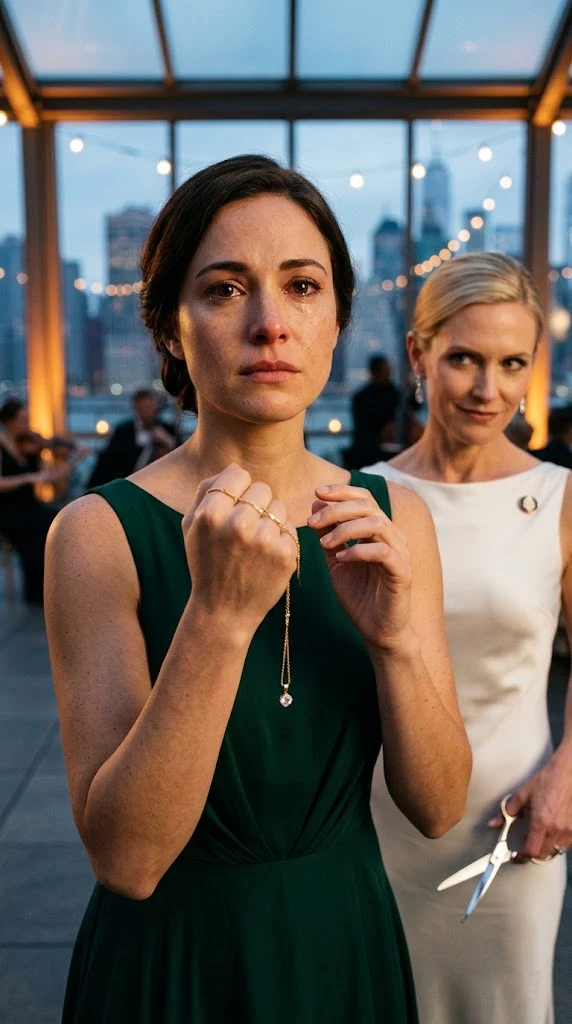
"This necklace was never yours — you stole it."
Vivian said it loud enough for the donor table behind us to hear, and then she cut the chain off my neck with a pair of catering scissors she'd been hiding in her clutch all night.
The chain dropped. I caught it in my palm without thinking, because it was mine — Daniel's grandmother gave it to me on our wedding day.
That was three minutes ago.
Let me back up, because you need to understand what kind of family I married into.
I'm Nora. I teach eighth-grade history in Queens. My husband Daniel is the younger Vance, the one who was supposed to run the foundation board until last year, when he quietly stopped showing up and started his own architecture firm out of a converted garage in Astoria. Everyone in that family thinks I did that to him.
The gala was at the top of the Vance building on Fifth — a glass conservatory wrapped around the roofline with a string quartet in the corner and the whole skyline burning orange behind the glass. Private aviation charity. Vivian was chair of the foundation, and the pin on her ivory silk gown caught the uplighting every time she turned.
Daniel had been strange all day. He wouldn't tell me why. He just kept saying, "After tonight, none of this touches you."
I thought he meant the gossip.
The necklace had been against my collarbone for two hours when Vivian walked up smiling, put her hand on my shoulder like a sister, and said, "Turn toward the photographer, sweetheart." I turned. Her left hand closed around the chain. Her right hand came up out of her clutch with the scissors.
Snip.
If you've ever had something cut off your body in a room full of people, you already know the sound is smaller than you expect.
Then she stepped back, lifted her chin, and said it again, louder. "This necklace was never yours. You stole it from my mother's estate."
I didn't scream. I didn't slap her. I stood there holding a piece of my own necklace while a hundred and fifty people in evening wear decided, in real time, what kind of woman I was.
The woman at the nearest cocktail table moved her purse off the table, like I might take it.
Vivian saw that, and that's when she smiled for real.
"In front of every donor here, you'll be finished," she said. "I know exactly what you are."
What was going through my head wasn't rage. It was the mill.
My grandfather ran a textile mill in Fall River, Massachusetts, and in 1976 it burned to the ground. He lost everything. He died eleven years later in a rented room with a photograph of the mill still on his nightstand. My mother kept that photograph. It's in a drawer in my apartment right now.
I was told it was wiring. Old building. Accident.
Standing there watching my sister-in-law perform my humiliation, I remember thinking — *she's not enjoying this. She's rushing it.*
Her hand had been shaking when she cut the chain. I felt it against my neck.
Daniel turned around at the sound of the room going quiet, and I watched his face change — confusion, then recognition, then something I'd never seen on him before, which was not anger but decision.
He crossed that floor in four seconds. He didn't grab her and he didn't yell. He stepped in front of me and said, in a voice that carried to the quartet: "Nobody touches my wife."
The board member nearest him — a man in his eighties with a white mustache, Mr. Aldous Crane — just looked at me. Then he looked at my face a second longer, and I saw something cross his expression I didn't understand. Recognition. He was looking at me the way you look at a photograph you haven't seen in fifty years.
Vivian didn't blink. "Daniel, this is not the place. She's wearing Mother's diamond. Ask her where she got it."
"I gave it to her," Daniel said. "In front of you. At the wedding."
A foundation trustee named Richard Hale materialized beside Vivian and put his hand on Daniel's chest. "Walk it back. Right now. Or you're out of the trust, out of the company, and out of this family."
Daniel stepped out of reach. "I signed the papers this morning."
Richard said, "What papers."
"My resignation from the foundation board. My withdrawal from the family trust. My share of the company reverts at midnight." He pulled a folded envelope from his jacket and held it up. "You want me out? I already left."
Vivian's face went white under the makeup. "You wouldn't."
"I did."
"You don't understand what you've done."
"No," Daniel said. "You don't understand what *you've* done. You had four hours to do this the decent way."
I didn't know what that meant. Standing there with my necklace broken in my hand, I had no idea who the man was walking through the doors at the back of the conservatory carrying a leather archive box under one arm, and no idea why Vivian — who gave a keynote at the UN two years ago without a note card — grabbed the edge of a cocktail table and held onto it like a woman on a boat.
Mr. Aldous Crane stood up out of his chair.
He was ninety-one. He almost never came to events anymore. He was staring at my face, and then he said, to no one in particular: "Fall River."
The room didn't hear him. I heard him. Vivian heard him. She went from white to gray.
The attorney put the archive box down on the cocktail table next to me — right next to the broken chain, which I was still holding, which I couldn't seem to put down — and said, "Mrs. Vance. I'm Stuart Halloran. I represent the Crane family's archive, not yours. I'm here because Mr. Crane asked me to bring something."
Vivian said, "Aldous. Don't."
And her voice cracked. In front of two hundred people.
Aldous Crane said, "Open it."
Everything up to this point had been about a necklace. I had spent twenty minutes being tried and convicted for a necklace.
Halloran opened the box. He took out a single sheet of paper in a plastic sleeve — old paper, yellowed at the edges, ink gone brown, and at the bottom a thumbprint pressed into a notary seal.
"This is a certified copy of the deed of transfer filed in Bristol County, Massachusetts, in June of 1976. It transfers the property at 41 Water Street from the estate of Walter Fenn, textile manufacturer, to Vance Textile Holdings."
Walter Fenn. My grandfather.
Vivian said, "That document was sealed."
And that was the moment the entire evening turned inside out, because a woman accused of theft does not get to hear the woman accusing her say the words *that document was sealed.* You do not seal a document about a necklace.
The room heard it. I saw the donor table behind her turn, slowly, like a line of birds on a wire all facing the same direction at once.
Daniel said, quietly, close to my ear, "I only found out this morning."
Halloran went on, flat and professional, every word landing like a dropped plate. "The insured property on the attached fire policy is listed as Vance Textile Holdings, beneficiary. The fire was ruled accidental on the basis of a signed report by Deputy Fire Marshal Edward T. Pruitt. That report was later withdrawn for review and never re-filed. The payout was three hundred and forty thousand dollars in 1976 currency."
Somebody at the back said, "Oh my God."
Vivian said, "My father was nineteen years old that year."
Aldous Crane said, "Your grandfather was forty-four. I sat next to him when he signed that policy."
Halloran turned the sleeve toward the room, and I saw the thumbprint at the bottom of the deed, and beneath it a signature: *Walter J. Fenn.*
I know that signature. I have a birthday card from my grandfather in a shoebox under my bed with that exact signature on it, the same loop on the F, the same break in the J.
But the deed doesn't just say he sold the property. It says he was *present* when it was signed. It lists him as a witness to his own sale.
Why would a man stand there and witness the sale of a business that was about to burn down three months later?
Which means one of two things, and I can't decide which one scares me more. Either my grandfather knew what was coming and was paid to sign — or he was given a choice he couldn't refuse, and whatever he was handed in exchange for that thumbprint never made it home to my grandmother.
Halloran had driven up to Fall River that afternoon with a court order that had been sitting granted for six days. Six days. Somebody in that family had been filing paperwork against a dead man's estate while I was picking out a dress.
And Vivian had known. Vivian walked up to me smiling for the photographers, put scissors on my neck, and cut off a gift from her own mother's estate — because a teacher from Queens was about to walk into that room wearing a necklace. The scissors weren't cruelty. They were a fire alarm.
Everything I had taken personally for two years was the same motion. Every time she looked at me she was looking at what my face might trigger in somebody old enough to remember.
Aldous Crane tapped a fork against his glass. Twice. The quartet stopped.
"Mrs. Vivian Vance, in my capacity as founding board member, I move to suspend the chair pending an emergency audit of the foundation's founding assets."
Somebody seconded it. I found out later it was a woman in a mint-green dress whose family lost a lumber yard in 1977 and never got an answer about why.
I did not feel vindicated. I felt terrifyingly visible. I was not the accused anymore. I was the evidence.
Vivian didn't run. She stood very straight and looked at her brother — not at me, at *Daniel* — and said, "You did this."
And Daniel said, "You cut her necklace off."
Security walked in through the conservatory doors, and two hundred guests watched a foundation chair with a pin on her shoulder being asked to step outside for the audit committee. I watched her touch that pin like she was checking it was still attached, and I watched her decide, right there, that she was going to walk out on her own feet.
She got three steps and turned around.
"Your grandfather," she said to me. Her voice was completely steady again, and that's what scared me. "Ask your family what he was carrying when he left the mill that night."
Then she let security walk her out, and I stood there with my husband's jacket around my bare shoulders and my broken necklace in my fist, and Aldous Crane said, quietly, "Nora. Do you know what your grandfather was carrying the night of the fire?"
And I said no.
And he said, "Then we need to talk before the auditors do."
That was nine days ago. There's a lawyer in my kitchen right now.
Because the fire marshal's report Halloran read aloud wasn't the only document in that box. There were two more pages under it. Halloran wouldn't let me see them. Aldous Crane took them, put them in his inside jacket pocket, and asked me one question about my grandfather's hands.
Not his name. His *hands.*
Tomorrow morning he's coming to my apartment. He said to bring the photograph. The one from my mother's drawer. The one of my grandfather standing in front of the mill.
Follow the link below for Part Two — what Aldous Crane says when he sees that photograph, what was in the two pages he wouldn't hand over, and the name my grandfather wrote down in the margin of a deed he signed in June 1976.
Advertisement