The Sergeant Called the Records Clerk a Paper Soldier — Then She Slid His Own Handwritten Evaluation Across the Clipboard Table
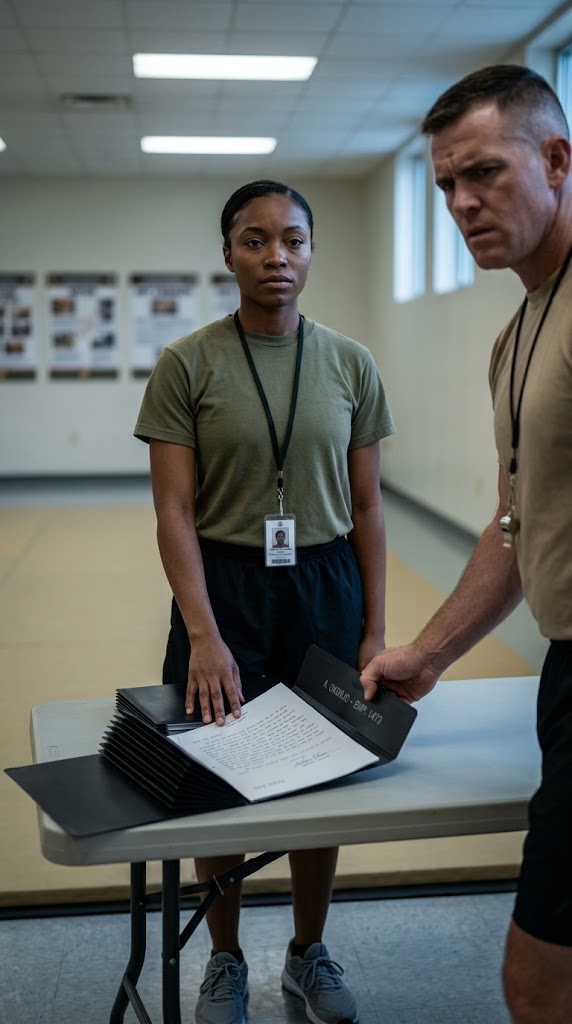
"You want the card, paper soldier? Say please."
Sergeant First Class Wade Halloran said it loud enough for the whole fitness annex to hear, and he said it with his open palm still flat on the clipboard, pinning Private First Class Aisha Okonjo's ID card to the table like it was evidence.
Aisha is twenty-six. Records clerk, garrison admin section. Six months of her life has gone into other people's promotion files, and this afternoon she needs exactly one thing: a certified fitness card so she keeps her berth and her pay-grade window. No card, and she's back to a line unit by Monday — a place she was never trained to stand.
Halloran is thirty-four, a squad leader, tall and loud and funny when he's winning. He volunteered to help proctor Warrior Readiness Certification Day because it pads his own promotion packet. He has never met Aisha. He still knows her full name and her exact section.
That's the first thing that doesn't fit.
She doesn't raise her voice. She asks him once, quietly, if he knows her name. He answers with her full name and her unit section in front of forty people, grinning, and the room laughs with him, because the room always laughs with him. Somebody behind the PT mat says something about clerks who want to play soldier. Halloran lets it land. Then he says it out loud, flat and unhurried:
"No card, no berth — you're back to the line by Monday."
She should fold. Everyone in the annex is waiting for her to fold. That's the version of this afternoon the room already rehearsed.
Instead she takes one step forward.
And here's the part the crowd never sees coming, because all afternoon they've been watching her hands — waiting for a fight, waiting for the mat — they were never watching the black accordion folder tucked tight under her right arm. She has not set it down once. Not while he shouted. Not while the laughter rolled. She's been holding it flat against her side for eleven minutes like it's the only bone in her body.
She opens it. She slides one stapled page across the clipboard table, face up.
Melanie Ortiz — civilian contractor, the annex's certifying proctor, a woman nobody in uniform can order around — reaches it before Halloran does. She's been quiet all afternoon. She's tired. She signs only what she has verified. She picks the slip up with her open hand, lifts it to chest height, and reads the first lines to herself.
Then she reads the last line out loud.
"Unfit — no spine for physical standards." A beat. "Signed, Halloran."
The room goes so quiet you can hear the fluorescent tube buzz over the lockers.
Because it isn't training paperwork. It isn't her file. It's his handwriting — block letters, heavy pen pressure, the way a man writes when he has already decided what he thinks — and it's an evaluation of her, written that morning, in a leadership assessment he was assigned to write about a soldier he had never met. Her name is spelled wrong. Three times. His signature is on the bottom with his last four digits, the way the G-1 section requires.
The same document feeding his own promotion board.
He calls her a paper soldier for wanting a card, and the paper in her folder is his, in his own hand, judging her for something he decided before he knew her name.
Melanie turns the page toward the light and circles the misspelling with her pen, slow and deliberate, and asks him the question that ends the afternoon:
"This signature is yours — so who exactly is being evaluated here?"
Halloran's hand is still reaching across the table. It stops in the air.
The laughter behind the mat dies in pieces, the way it always does — one soldier first, then two, then the whole row of them suddenly very interested in the floor. His squad is standing eight feet away with their arms crossed. None of them will look at him now.
Melanie marks Aisha's card certified — by proctor, her own signature, her own initials — and clips it back to the roster. She doesn't look up. She says the slip is going to the garrison G-1 section for review, today, before 1600. Then she tells Halloran to report to his first sergeant before end of day, and says it in the same flat tone she uses to read the roster, which is somehow the worst part.
He was never the one holding the test.
He was the one taking it. And he signed it himself, that morning, in ink, without reading what he was really admitting: that he'd judge a soldier he'd never met and put his name under it — which is exactly what a leader is supposed to be graded on.
Aisha takes her certified card. She tucks the folder back under her arm. She says thank you, ma'am, the way she'd say it to anyone. Then she steps back toward the PT mat, and that's when Halloran finally turns his head and says it low enough that only the three of them hear:
"Who gave you that folder?"
She looks at him for a second. She doesn't answer. And that's the thing that will keep him awake after his first sergeant finishes with him — not the signature, not the misspelling, not the room going quiet. It's that she knew exactly who he was before he ever opened his mouth.
So did whoever routed his own worst draft to her desk that morning.
The rest of the story is where this gets worse for him — and better for her than anyone in that annex could have guessed. The link below picks up the second the room empties out: who signed the folder over to her, what the G-1 review turned up, and the one line in his own file that Halloran never thought anyone would read. 👇
Advertisement