She Counted the Show Chairs While the Secretary Read Her Late Mother's Plot Number Wrong
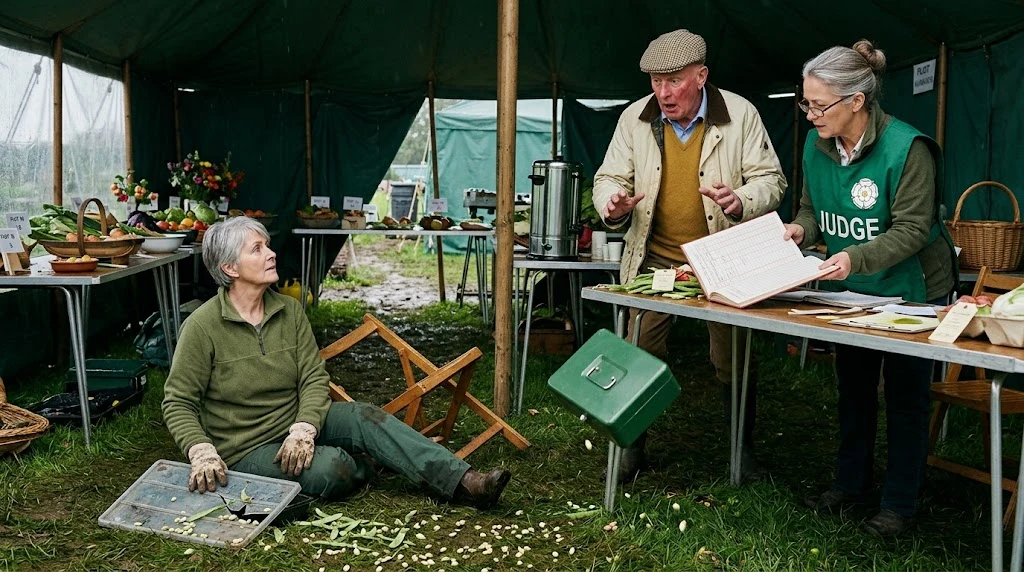
"That seat's for entrants," Gerald Pink said, and flicked the rear leg of Nell Attwell's folding chair with the toe of his right wellington.
Nell had held plot 22 for six years. She had grown the best runner beans on the site, the same way her mother did for thirty. And she had watched Gerald Pink run the show, the waiting list and the entry book as if the whole allotment were his private garden — moving map pins, taking cash for plots that were never his to let, correcting her entry tags by one digit every single year.
This morning, on judging day, he corrected her plot number again in his red pen, without asking. Then he walked back, said the chair was for entrants only, and put her on the wet grass in front of the whole marquee. Her seed box cracked on one corner. A hundred runner-bean pods scattered left across the path. The room went quiet enough to hear the canvas breathe.
She didn't shout. She picked the pods off the wet path one at a time, because they were her mother's seed and there was no year left to waste.
Gerald kept his hand flat on the green cash tin while he told the marquee that all late entries were rejected and the waiting-list families had been informed. He said he'd "never met" most of them.
Then Mrs Ainsley Vowles arrived from the regional federation, in her RHS judge's tabard, and asked for the site register.
The register lives in the cash tin.
Here is the part that matters. The register is a ruled double-page book, and Nell's neat blue-black hand fills the left column: entry number 41, plot number 22, runner beans, one entry. On the facing right page, the same entry number 41 appears again — this time in Gerald's bigger slanted blue ballpoint, plot number 21, runner beans, one entry. Directly underneath it, in the same blue pen, is his own countersignature dated the 14th of June.
The same beans, entered twice. Under two plot numbers. One of them, in his handwriting.
Nell said one sentence to the judge. Four words.
"Read the right column."
Ainsley Vowles put on her reading glasses slowly, the way a person does when she wants the room to wait, and she read. Then she turned the open double-page toward the marquee, so everyone could see the two rows sitting one above the other under the same heading, the same entry number in both, two different pens.
Gerald backed up. His right heel caught the foot of the side table. The tea urn rocked, the cash tin slid off the edge and cracked open on the grass, and brown envelopes stamped with the waiting-list families' postcodes fanned out along the path.
He said the money was "admin."
Nobody moved to help him pick it up.
Nell stayed exactly where she was, seated on the wet grass at the left of the frame, one glove flat on the lid of her cracked seed box, eyes up on the register. Gerald's face had gone the colour of his waxed jacket.
Then the judge lifted a second page out from behind the register — a page Nell had never seen in her life — held it level in the green light through the canvas, and said six words.
"Mr Pink, this is your signature too, isn't it?"
The marquee went so still that the chair ticking in the breeze was the loudest thing in it.
Nell has never opened that second page. Neither has Gerald — not since that morning. But the story of what's on it, the waiting-list money, the site meeting that followed, and the one folding chair on plot 22 that nobody pulls out from under anybody any more are all written up in the comments below.
What do you think Gerald Pink signed that had nothing to do with beans — and why did he go white before the judge had even finished the question? Tell me in the comments. The full story is in the comments below.
Advertisement