She Shoved the Clipboard Into a Quiet Soldier's Chest — Then Read the Rank on His ID
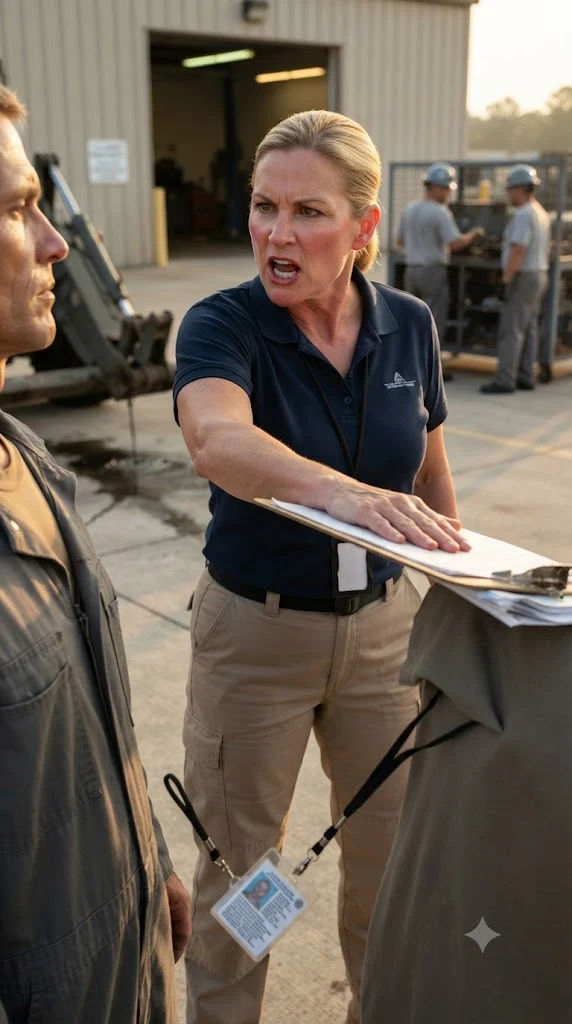
The clipboard was still in her hand when she drove it flat against my sternum and said, "You broke the lift arm — you're paying for it."
I didn't step back. I didn't say a word. The concrete pad was hot through my boots, and every worker in that equipment yard had stopped to watch.
Denise Falk had run that motor pool for six years, and in six years nobody had pushed back. She was the loudest voice on-site, the one who signed the paperwork and decided who got blamed when something went wrong. That afternoon, something had gone very wrong — a hydraulic lift arm on Bay Three had come down cracked and weeping fluid onto the concrete, and Denise needed a name to put beside it.
She picked mine.
I was three weeks into a medical hold, assigned to light duties, wearing plain gray coveralls with no rank patch and no unit insignia. My ID was tucked under my shirt on a lanyard. The only thing anyone in that yard knew about me was that I didn't talk much, I kept my boots clean, and I was working alone near Bay Three that morning.
That was enough for her.
By the time the shift changed over, Denise had her version ready. I'd been careless with the lift controls. I'd ignored the lockout procedure. I'd damaged government property and I was going to pay for the repair out of my own pocket, or she'd file a report that would follow me for the rest of my career.
"You think this is a joke?" she said. The clipboard hit my sternum, hard enough to make my dog tags click. "Fourteen thousand dollars to replace that arm. Fourteen. And you're standing there like you're waiting for a bus."
Two of her crew had drifted in from the tool cage. A young specialist from the motor pool was pretending to coil a hose about thirty feet away, watching out of the corner of his eye. Nobody moved to help me. Nobody moved to stop her.
I've been in the Army twenty-two years. I've deployed to two combat theaters. I've buried soldiers I trained. I know what fear feels like in a room, and I know what it looks like when a crowd agrees with the person who's yelling.
This wasn't fear. This was a woman who had already decided the truth was negotiable.
"I'll have your career for this," she said, quieter now, which is always worse. "Light-duty washouts think they can coast. You're about to find out what happens when you coast around me."
I looked at her the way I look at a target I'm not ready to engage. Steady. Patient. Waiting for the right moment.
"Ma'am," I said, "the damage was documented this morning."
That stopped her for maybe a second and a half.
"Documented." She laughed — a short, ugly sound that made one of her guys look at his boots. "Documented by who? You? You're a body in coveralls, pal. Nobody here is going to believe a light-duty nobody over me."
She turned to the workers, arms wide like she was presenting me at a county fair. "This is what I deal with. This is what I get."
A couple of them laughed. Not because it was funny. Because she was the one who signed their timesheets.
I let her finish. That's a habit I picked up a long time ago — let people say the whole thing. Let them hear themselves.
"You're not even going to answer me?" She stepped in close enough that I could smell the coffee on her breath. "You know what your problem is? You don't understand how this place works. Rank matters here. Rank matters everywhere. And you don't have any."
"I'm aware of that," I said.
She blinked. It wasn't the answer she'd scripted.
"What's that supposed to mean?"
Behind her, the maintenance building door opened. Rick Delgado, the regional contract manager, came out with a tablet in one hand and his reading glasses in the other. He'd been in the office all afternoon doing quarterly reviews. Nobody had told him what was happening in his own yard.
Denise didn't notice him. She was too busy winning.
"Here's how tonight goes," she said, tapping the clipboard against my chest once more. "You sign this acknowledgment. You agree to the repair cost. Or I walk this into the commander's office Monday morning and I tell them exactly what kind of soldier they've got on light duty."
I looked down at the clipboard.
Then I looked at the bottom of the work order clipped to it.
Denise Falk's signature. Black ink. Neat, practiced loops. She'd signed it that morning at 7:42 a.m. — the inspection form I'd filled out when I walked Bay Three and found the lift arm already cracked and leaking fluid onto the pad. The form that documented, in my handwriting and her signature, that the equipment was damaged before I ever touched it.
She'd signed the paper that saved me. She just didn't remember doing it.
"You want an acknowledgment," I said. "Fine."
I reached under the collar of my coveralls and pulled the lanyard out. The laminated card came up easy — it always does, it's on a breakaway clasp for a reason.
I held it at chest height, facing her, the way you hold something up for a customs officer.
For a second, nothing happened. Her eyes went to it the way eyes go to any shiny object in an argument. Then they stopped.
Then they read.
Denise's mouth opened and closed once. Her hand, the one holding the clipboard, dropped slowly to her side. The clipboard bumped against her thigh and stayed there.
"That's — " She stopped. Swallowed. Started again. "That's not possible."
"It's dated this morning," I said. "I reported in at zero seven thirty. I'm on medical hold until the end of the month, and then I take over as command sergeant major of this installation."
The yard was completely silent. Even the hose stopped moving. The specialist had turned all the way around now, mouth open, and two of Denise's crew were staring at each other like they'd just watched a truck drive through a wall.
"Nobody told me," Denise said, and her voice had gone thin and young in a way that made her sound like a different person.
"No, ma'am," I said. "Nobody told you. That's generally how a medical hold works."
Rick Delgado was standing about ten feet behind her now. He'd heard the last part. He looked down at his tablet, tapped something, and his face did the exact thing faces do when a form they signed that morning suddenly matters more than they expected.
"Denise," he said.
She turned. She saw him. Something in her spine changed — the way a person's whole body changes when they realize the room has more exits than they thought and all of them are locked.
"Mr. Delgado — "
"Give me the clipboard."
She did. Her hand was shaking. Not much. Just enough.
Rick read the work order. He read it the way a man reads something he knows is going to cost him money. Then he looked at me — at the ID still hanging in my hand, at the coveralls with no rank patch, at the boots I keep clean because that's what I was taught.
"Sergeant Major," he said. "I was not informed you were on-site today."
"You weren't supposed to be," I said. "That's the point of a medical hold."
He nodded slowly. Then he looked at Denise, and his voice didn't change at all, which was somehow worse than if he'd yelled.
"Denise, come inside. We're doing a contract review. Right now."
She didn't move.
"Denise."
"I need to — " She looked at me. Her eyes were wet and furious and, behind all of it, terrified. "I need to say something first."
"You can say it inside," Rick said.
Her jaw worked. She looked down at my ID one more time, and I watched her do the math. Twenty-two years. Three combat deployments. Two Bronze Stars. Command Sergeant Major, the senior enlisted leader of an entire installation — a position that outranks every captain, every major, every lieutenant colonel on the base.
Including her. Including every lieutenant colonel she'd ever leaned on her rank with.
She turned and walked toward the building. Halfway there, she stopped and looked back at me.
"For what it's worth," she said, "I didn't know."
"I know you didn't," I said. "That's why it happened."
She stared at me for a second, and then Rick put a hand gently on her shoulder and steered her through the door. It clicked shut behind them. Through the window, I could see her sit down in a chair across from his desk, and I could see him pull up a file on his tablet, and I could not hear a single word.
The specialist had dropped the hose. Two of Denise's crew were still frozen by the tool cage, holding wrenches they'd forgotten they were holding.
One of them — a guy in his fifties with a sunburned neck — finally spoke.
"Sergeant Major," he said. "Uh. Sorry about all that."
I put the ID back under my collar. It settled against my chest like it always does, warm from my own body heat.
"Nothing to be sorry for," I said. "You didn't do anything."
He looked at the maintenance building door. "What's going to happen to her?"
I didn't answer, because I didn't know yet. Rick was in there right now, and somewhere in the next hour, he was going to come back out and ask me one question. He'd ask it the way officers always ask it — carefully, formally, leaving me every possible exit.
And I'd have to decide whether a woman who'd spent six years screaming at people beneath her deserved to lose everything she'd built, or whether one afternoon of terror was punishment enough.
The sun was going down behind the tool cages. Fifteen grand worth of damaged equipment sat on Bay Three, exactly where it had been that morning when I wrote it up and Denise Falk put her signature under my handwriting without reading a single word.
Officers get trained to think about consequences.
Nobody trains you for the moment you realize you're about to become one.
The office door was still closed. The light inside was on. I could see the shape of her through the blinds, sitting very still.
And I could see Rick Delgado picking up his phone.
**What would you do if you were standing in those boots?** The full story — every word inside that office, what Rick found on the tablet, and the question he asks the Sergeant Major at the end — is at the link below. Read it and tell me if you'd have given her a second chance.
Advertisement