The Staff Sergeant Made My Soldier Empty His Pockets — So I Held Up What He Shredded
"Empty your pockets, Nash. On the hood. Now."
Staff Sergeant Curtis Hoyle said it loud enough for every one of the forty soldiers standing at Friday close-of-maintenance formation. Loud enough for the maintenance annex. Loud enough that First Sergeant Dale Rourke, watching from his open window office above the line, could not have missed a single word.
Nash is nineteen. He is a wheeled-vehicle mechanic who has not yet even made the deployment roster. His wrists are too thin for his sleeves. And he did exactly what a nineteen-year-old does when a staff sergeant says "now" — he stepped forward and turned out his pockets onto the truck hood like he was shown.
Wallet. Phone. A folded letter from his mother.
Hoyle swept even the letter aside with the back of his hand so the whole line could hear it scrape across the metal.
"Nash signed out that arms-room key," Hoyle announced, walking the length of the hood like it was a stage. "And it hasn't come back. You know what that makes him? A thief. A coward, hiding behind a letter from mommy."
Some of the platoon looked at the concrete. Some looked at their boots. That is how a motor pool learned to behave under this man — you looked away, or you became the story.
Except one thing did not fit.
I've run the sign-out roster for this battalion for eleven months. Entry 88 — the arms-room key. I could recite it before Nash's pockets finished emptying. And I knew, standing there in the diesel haze with my clipboard under my arm, that what Hoyle was saying was false.
I also knew something else that Hoyle did not know I knew.
The night before, I had pulled three carbon copies out of the red shred bin behind the motor desk.
Let me back up, because this didn't start with Nash and it didn't start Friday.
Four months ago, a specialist from second platoon came to my desk after duty hours and asked, very quietly, how you file an equal opportunity complaint. I handed him the form, explained the process, gave him a tracking number, and told him nobody would bother him for using it.
Ten days later I looked him up on the roster. Gone. Transferred off the post under "administrative actions," no forwarding brief, nothing attached to his name.
Two weeks after that, a junior mechanic from the annex filed the same kind of complaint. Same process. Same number issued. Ten days. Gone from the roster.
Third soldier. Fourth month. I watched it happen the same way you watch a car with bad brakes slide through the same icy corner — you know the ending before it arrives.
This time, I didn't just issue the number. I kept a carbon copy of the form before it went upstairs. Yes, that's outside procedure. No, I don't regret it. When a paper trail starts dying before it reaches anyone who can read it, you stop trusting the trail and start trusting your own hands.
And here's the part I only learned because the man who laughed got chatty: the night each complaint "failed," the red shred bin by the motor desk got heavier. Staff Sergeant Hoyle's bin. His desk. His disposal.
SPC Trent Geller was the one who laughed. When Hoyle performed one of his Friday shakedowns, Geller laughed harder than anyone, at all the right beats. It took me weeks to understand that Geller wasn't enjoying it. He was staying close enough to see. And one evening, chewing on a cigarette he never lit, he told me, "Check the bin before Thursday, specialist. He sweeps it Thursdays."
So I did. I waited until dark, tipped the bin's contents onto my desk under the printer light, and went through it page by torn page.
Three carbons. Three complaint forms. Three purple stamps across all of them, so sharp you could read them across the room: REJECTED — NO ACTION. Ten days or less on every one. And in the signature block, where a decision authority initials the disposition — the same two dark purple letters on all three.
D.R.
Dale Rourke. First Sergeant Dale Rourke. The man with the open window who watched everything on this line.
The friendly one. The one who shook my hand during inprocessing and asked about my hometown.
That was Thursday night. Friday was Nash.
That's how a quiet records clerk ends up watching a staff sergeant turn out a teenager's pockets with the whole formation holding its breath — knowing, in a way nobody else in that formation knows, exactly what this performance is for.
Because here is the thing I want you to hold onto: Nash never signed out that key.
So when I tell you that I stepped between them, understand I wasn't rescuing Nash from a mistake. Nobody in that chain reacts that fast to an honest mistake.
"Staff Sergeant," I said — and I made sure my voice stayed level, because the moment you shout at a man like this, you hand him the scene — "it was never signed to him. Look at the tag."
Hoyle turned around like he'd forgotten furniture could talk.
There is a specific silence that falls on forty soldiers when the person speaking is the rank nobody guards against. I want you to imagine it. Nobody moved. The radio on the desk squawked into it and got told to shut up by nobody.
"You were in the records?" Hoyle asked.
"I am the records."
He did something then that I will never get out of my head. He looked up, past my shoulder. At the First Sergeant's window. Rourke was standing at it. I don't know what passed between them — maybe nothing, maybe everything — but Hoyle's jaw reset, and he decided to spend the problem instead of absorbing it.
He crossed to the motor officer's steel desk — the one pushed into the bay for the inventory — snatched the sign-out roster off it, and backhanded the entire thing onto the floor. Pages fan out. The pen skittered under a truck.
"None of you get to question the roster," he said, and his voice had climbed a register like it does on Fridays. "You especially. Clerk. You want a career after this deployment cycle? One word from me is a sunset on it."
That's the moment where most people in that formation would have gone back to staring at the concrete.
And that's the moment I want you to ask yourself the question I've been asked a hundred times since: what do you actually do, when you are the lowest-ranking person in the building, and the man threatening you answers to someone above him who initials every buried complaint?
You don't shout. You don't cry. You don't appeal to his decency, because there isn't a spare scrap of it in inventory.
You do what the Army trained you to do in every other part of your life: you bring the records.
I had three torn carbon copies in a manila sleeve under my clipboard. I'd carried them all formation, the way you carry something you've rehearsed in your head for a month — half hoping you'd never need it, half terrified you wouldn't have the nerve.
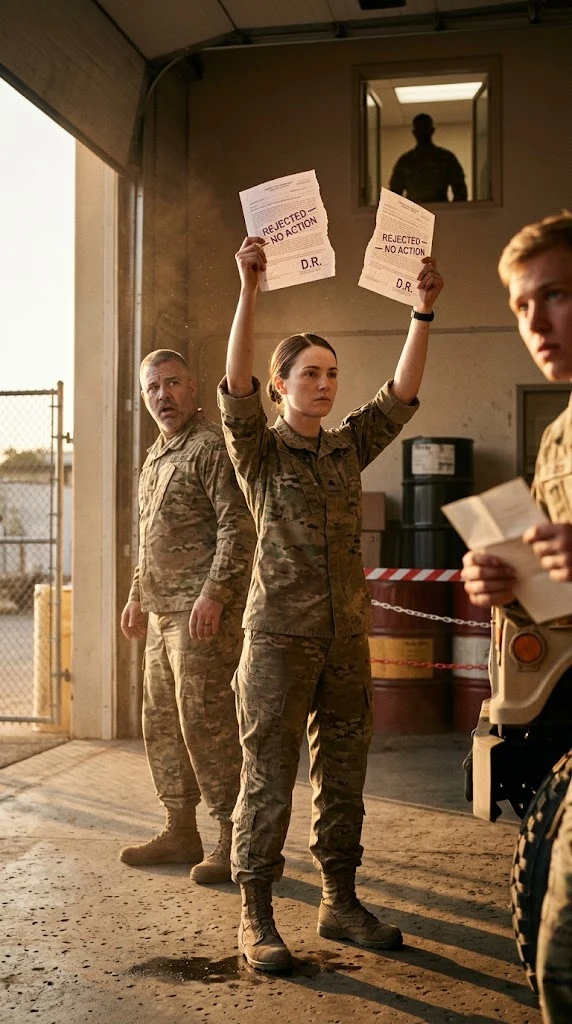
I raised them high. Over my head, at full extension, angled toward the formation — and angled just as deliberately toward that open window.
Golden hour was coming through the bay door exactly the way it does at 16:10 in October, straight across the line, and it caught those carbons the way it catches nothing else. Purple stamps. Big enough to read from the third truck. Torn edges from the bin. And the initials in every signature block. D.R. D.R. D.R.
"Three complaints," I said, and this time I did raise my voice, because the paper was doing the acting and I was just the hand. "Filed across four months. Stamped no action in under ten days, every one. Your shred bin kept them, Staff Sergeant — and the initials rejecting them belong to the man in that window."
I'm told the formation made a sound like a crowd at a game when the other side scores. I didn't hear it the way they heard it. What I saw was Hoyle's face.
Remember, I told you this man performs anger. What came off him when those carbons went up was not anger. It was the specific gray stillness of a man watching the leash in his own hand turn out to be a collar of his own.
"Who put you up to this?" he said, and it came out thin.
Nobody answered him, because the answer was in my hand and on the floor under forty boots — the roster entry that proved the key was never Nash's at all.
The First Sergeant's blind pulled down.
That sound — the slat-click of a window blind dropping in an office where a man had watched every formation for a year — was louder than anything Hoyle had said all afternoon. Nash's mother's letter was still lying on the truck hood, and he picked it up slowly, like it belonged to somebody else.
The MPs reached the motor pool in under ten minutes from the moment the papers went up. Not for me. Not for Nash.
For Hoyle — walked to the chain-link gate in front of the same forty soldiers he'd spent two years teaching to look at the floor. And for First Sergeant Dale Rourke, who was met at his bay door by a Lieutenant Colonel from theater Inspector General who had, by some administrative miracle, actually been copied on a complaint that finally made it out of this post. The Colonel summary-relieved Rourke where he stood.
But the MPs didn't tell Hoyle to stop talking, and Hoyle didn't stop. Handcuffed to the bumper by the pump-pad gate, he caught my sleeve and said the sentence that hasn't let me sleep since:
"Specialist. Write it down. Everything. Who told me which soldier. Which week. Put it in writing before they make me disappear like the paper."
So now the file is open, it is external, and it has my name on the sworn statement under it.
Click the link below to read what First Sergeant Rourke said when the MPs reached him — why Hoyle still won't name him officially, and the complaint number that finally came back from Army IG 👇
Advertisement