The Supply Sergeant Called Me the Laundry Girl on the Dock — Then I Put His Own Signed Requisition on the Table
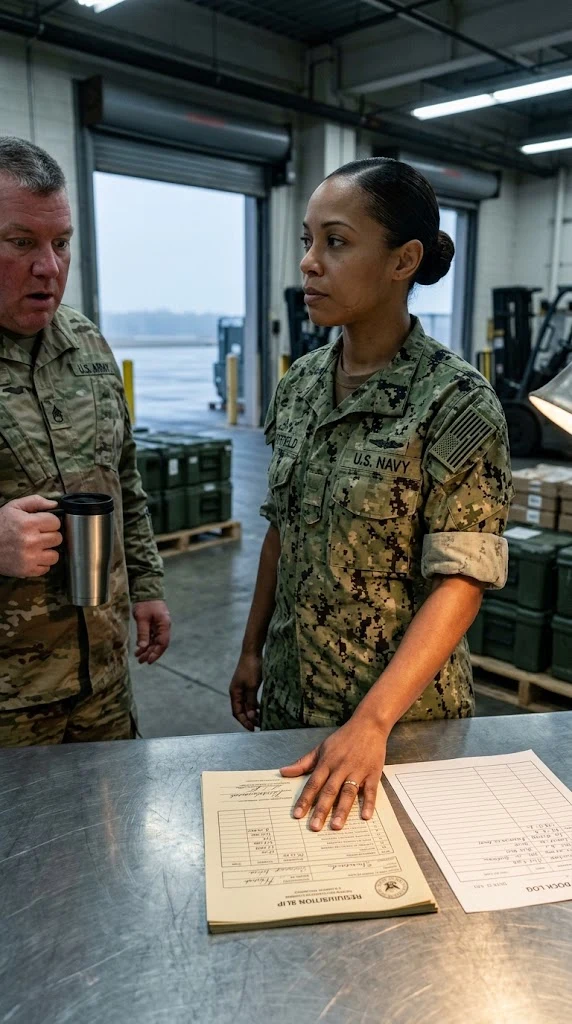
Sergeant Trigg slammed his inventory clipboard onto the inspection table hard enough to send the pen rolling into the drain grate, and said it loud enough for the whole dock: "She signed for twelve crates of cold-weather gear and only eight came off my truck. Whitfield's been stealing from this depot since the day she got here."
Two dozen soldiers and sailors went quiet. Four days of jokes about the laundry girl, and now they finally had their proof.
I didn't say anything. I stood on my side of the table with my metal clipboard against my chest and let him finish.
My name is Petty Officer First Class Dana Whitfield. Twelve years active, logistics chief on this joint base. I have a nineteen-year-old son in A-school and nineteen months left before I can put in my papers with a clean record.
If that accusation holds, I lose everything. Rank, billet, and a career-ending disciplinary mark that turns twenty years into a discharge instead of a pension.
The thing is, I could have ended it on day one.
On day one he stood on the tailgate of his truck and called me the laundry girl because I came from the naval side of a joint depot, and every sailor in earshot pretended they didn't hear it, and every soldier in earshot laughed. I checked the pallet count and said nothing.
On day two I found something that didn't fit. Same twelve crates, two different dates on paper — the dock log listing them outbound on a Thursday, the manifest logging them received on a Tuesday, and both sheets countersigned in the same blocky handwriting in the corner. I stood under the fluorescent light and did the arithmetic three times.
On day three, a junior sailor named Pena mentioned something without knowing it mattered. He said Trigg's civilian truck had been parked at the back gate late the same night the crates went missing, and that he'd had to walk around it to get to his own car.
I wrote that down too. That is the part people get wrong about me. I don't confront. My first chief told me once, when the shortages started and I asked what I should do, that a screaming match is a gift to a man like that. She said keep records instead. Keep every one.
So for four days I kept records, and I let him talk, and I let them laugh, because the crowd is the only witness that ever matters on a dock like this.
That morning, before anyone clocked in, I photographed the manifest with his initials in the margin.
Trigg took my silence for empty hands. That was the whole mistake.
"Everybody here knows what you are," he said, standing over the table with his coffee in his left hand and his other finger pointed straight at my sternum, close enough that I could smell it. He never touched me. He didn't have to.
"Say one more word," he said, "and I'll end your career on this dock."
There is a particular quiet that comes over a working dock when a threat lands in front of two dozen witnesses. The forklift was still idling by the roll-up door. Nobody breathed loud enough to be heard over it.
And I did what I've done every day for four days. I said nothing.
That's when the part they didn't expect started.
My chief petty officer has a phrase for men like Trigg: he performs best for an audience, so give him one, and then take it away. I had a clipboard in one hand, and under my left arm a sealed manila folder nobody in that room had ever seen, and I had been carrying it into this dock every morning since day two waiting for exactly this.
I reached past my own clipboard and set the folder down flat on the inspection table.
"Then read this," I said.
That was my whole contribution. Four words.
Trigg watched me open it. I pulled out one page — a requisition slip, thick stock, dock light falling across it — and laid it on the table beside the dated dock log in my own handwriting. Side by side. The way you put two things together when you want someone to stop talking.
Senior Chief Petty Officer Lena Marsh had been standing behind the table the whole time with her reading glasses on her cord, saying nothing, watching. Twenty-eight years. Nobody on that base questions her. She stepped forward and used the cap end of her pen to smooth the paper flat.
Then she read it out loud, in a voice like a door closing.
"Sergeant, this is your signature."
The dock went completely silent. Not the held-breath silence from before. The other kind. The kind where people stop enjoying themselves.
"You signed those crates out yourself," she said. "Twelve items, cold-weather gear, itemized. Your initials in the margin. Four days ago."
Somebody behind me shifted their boots on the concrete. I didn't turn around to see who.
Trigg's jaw came loose. His mouth was still open from whatever he was going to say next, and it just stayed there, and the coffee cup in his left hand tilted about ten degrees before he remembered he was holding it. He looked down at the paper. Then at my chief. Then at the paper again, like it might have changed.
Behind me, four days of laughing drained out of that building in one motion.
Senior Chief Marsh didn't raise her voice either. She took his clipboard out of his hands the way you'd take a knife off a child — without hurry, without an audience-pleasing flourish — and she told him the master-at-arms had been standing at the bay door for the last minute, and that he should consider himself relieved of dock authority pending a formal investigation.
Then Senior Chief Marsh turned to me. Her voice changed completely. Softer. Respectful.
"Petty Officer Whitfield," she said. "Walk me through the entire quarter. Every manifest. Every signature."
Two of the men who had laughed the loudest on day one stepped forward before I could answer. One of them said he had statements to add. The other one just said, "Me too, Chief."
I picked my clipboard back up. Red tag, pen clipped to my collar, hands steady.
And I reached for the second folder — the one still down at the bottom of my bag, the one nobody in that room had seen, the one I have never once opened in front of another human being.
The full story — what happened to Trigg, what was in the second folder, and what the depot did the following Monday — is in the first comment 👇
Advertisement