The Whole Room Laughed When Sergeant Strand Kicked the New Transfer — Until the Envelope Opened
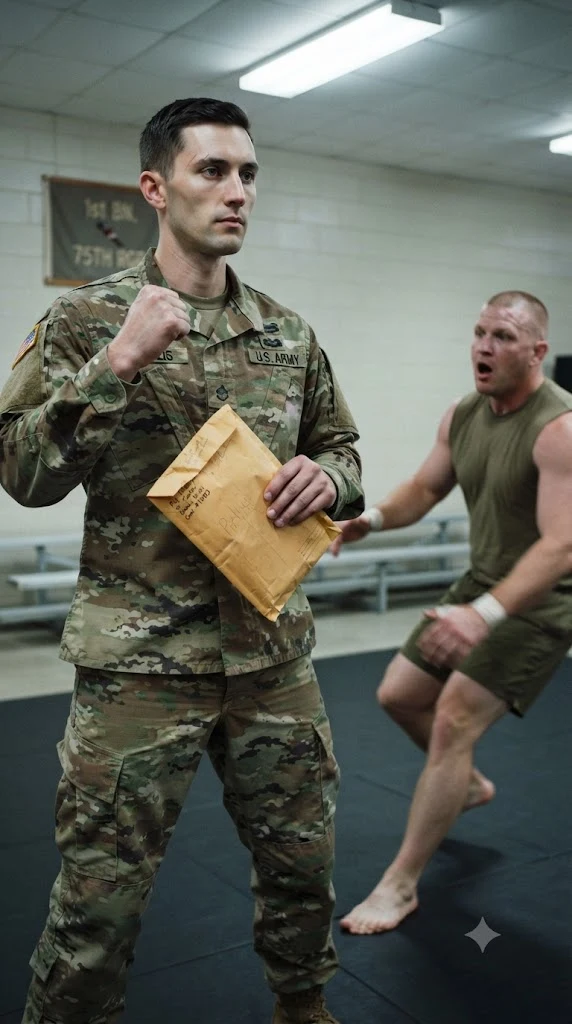
"You lost, princess? This isn't yoga class."
Sergeant Brock Strand said it loud enough for the whole combatives room to hear, and his forearm took the training clipboard off the corner table with it. Papers skidded across the rubber mat. Nobody picked them up. Nobody ever picked them up in that room.
Specialist Owen Hollis had been at Fort Darrow three weeks. Three weeks of keeping his head down, sleeves a touch long, a unit crest pin sitting perfectly straight on his left breast, and a gear bag he never let anyone else move. Twenty-nine years old, quiet, polite, the kind of soldier a room like that chews up on a Tuesday afternoon and forgets by Wednesday.
He was supposed to be the joke. That was the plan.
Strand was a legend in his own mind — six feet of shoulders and volume, sleeves cut off, wrists taped, a pale scar running through his buzz cut like a crack in a windshield. He had spent four years being the loudest man in a room of people trained to stay quiet, and he had learned the trick that kept working: pick the new guy, pick him in front of everyone, and let the laughter do the rest.
Hollis stood at the near-left of the mat in a stance the room didn't recognize. Weight on the back foot. Hips slightly bladed. Eyes on Strand's chest, not his hands. Not the stance of a man about to get embarrassed. The stance of a man reading a body the way other people read a menu.
Nobody in that room had time to notice.
"Light contact," the instructor called from the edge. "Watch the feet."
Strand didn't watch anything. He threw a lazy, contemptuous kick at stomach height — not to hurt Hollis, which would have been something, but to make him flinch. A flinch was the whole point. A flinch gets replayed at lunch for six months.
The boot was already in the air when the room went quiet.
The room went quiet because Hollis simply was not there when it landed.
It wasn't a block. It wasn't a counter. It was a single small pivot — hips rotating a hand's width, one half-step off the line — so small that from the bleachers it looked like nothing had happened at all. The kick cut empty air with a soft, stupid whoosh. Strand's weight tipped over his front foot and he caught himself a half-second too late, arms flailing once, feet scrambling, a big man briefly and very publicly falling in love with gravity.
Somebody on the bleachers laughed. Then stopped. That was worse.
Hollis hadn't struck back. Hadn't raised his hands. He stood exactly where his step had left him, hands relaxed, breathing unchanged, looking not at Strand but at the doorway behind him.
"I didn't move," Hollis said quietly, to no one in particular. Which was technically true and somehow worse than any insult.
Strand's face went from red to worse. He straightened up, jabbed a finger at Hollis's chest, and found his volume again: "You think that's funny, princess? Scrub this whole room by lunch. Every mat. Every corner."
The room laughed on cue. That's how it worked in there. The room always laughed on cue. Hollis just nodded and said, "Understood, Sergeant," which is what a scared new transfer says.
Except his stance never changed. He was still bladed. He was still watching throat height. He was still reading the room instead of the man.
The door at the back opened.
First Sergeant Imelda Darrow walked in like the climate had changed — compact, upright, sleeves rolled, reading glasses looped on her collar, a folded service record in one hand and no hurry in her step. The laughing stopped in sections, like lights going off in an office building. Strand straightened. Nobody was sure what they were standing at attention for, but they were standing at attention.
She didn't ask what happened. She looked at the clipboard and the scattered papers on the mat, then at Hollis's gear bag by the wall, then at Strand. Then she crouched and flipped the bag's front flap open with two fingers, the way you'd handle evidence, and pulled out a folded intake envelope with a pencil annotation on the corner.
That's when the room got really quiet. The kind of quiet where a rubber mat squeaks when someone shifts their weight.
Darrow opened the record, put her reading glasses on, and read one line from the deployment tab the way you read a receipt out loud so the whole table hears the total.
"He was a close-quarters instructor in Khost," she said. "You just missed him."
Nobody laughed. Somebody on the third bleacher row said "oh" out loud, very softly, and immediately wished they hadn't.
Strand's mouth opened and then closed. His eyes went to the pencil annotation on the corner of the record, then to Darrow's face, then — slowly, the way a man turns when the floor beneath him has changed shape — to Specialist Owen Hollis, standing on the mat with his hands relaxed, breathing the same as ten minutes ago.
There was a moment where you could see it land on him. That the guy he'd picked for the joke was three weeks into doing what he'd been ordered to do, and that the whole humiliating little performance had been the exam. That the transfer didn't flinch because nothing in that room was faster than he was.
Darrow folded the record. She didn't raise her voice. She didn't need to.
"Sergeant Strand. You'll drill under Specialist Hollis for the next two weeks."
The room didn't laugh. That was the whole point — that's the sound this story is about.
You'd think that's the end of it. It isn't. The file has more pages, and the first morning Sergeant Strand had to answer to the man he mocked is the part nobody tells you about.
**Why was Specialist Hollis's file sealed in the first place — and what's on the pages First Sergeant Darrow never read out loud?**
You'll find out inside. Read the full story before you go. 👇
Advertisement